
SymphonyFountains Commercial fountain projects demand more than a dramatic flame. They require controlled combustion, stable water flow, reliable ignition, and careful coordination with pumps, lighting, drainage, and site safety systems. A Fire Ball Fountain Nozzle must perform consistently during long operating periods, not only during a short product demonstration. Small differences matter. A slightly uneven flame can disturb the visual rhythm, increase maintenance needs, or expose weaknesses in the installation.
According to commercial fountain engineer David Stone, “A successful fire feature begins with control, not spectacle.” This principle guides our selection of the seven best Fire Ball Fountain Nozzles for commercial projects. Each option should be judged by flame shape, material quality, fuel efficiency, water interaction, cleaning access, and compatibility with professional control systems. Stainless steel construction may resist harsh environments, while precision outlets can create a smoother and more balanced fire pattern. These details become visible across a hotel entrance, public plaza, resort pool, or retail development.
The ranking is not absolute. Site conditions change everything. Wind, water chemistry, fuel supply, local engineering requirements, and maintenance access can alter performance. Even an impressive nozzle may disappoint when matched with the wrong pump or basin design. That is worth remembering. A beautiful flame does not excuse poor planning. This guide focuses on practical performance, visual impact, and long-term serviceability, while recognizing that every commercial installation needs qualified design review and responsible operation.
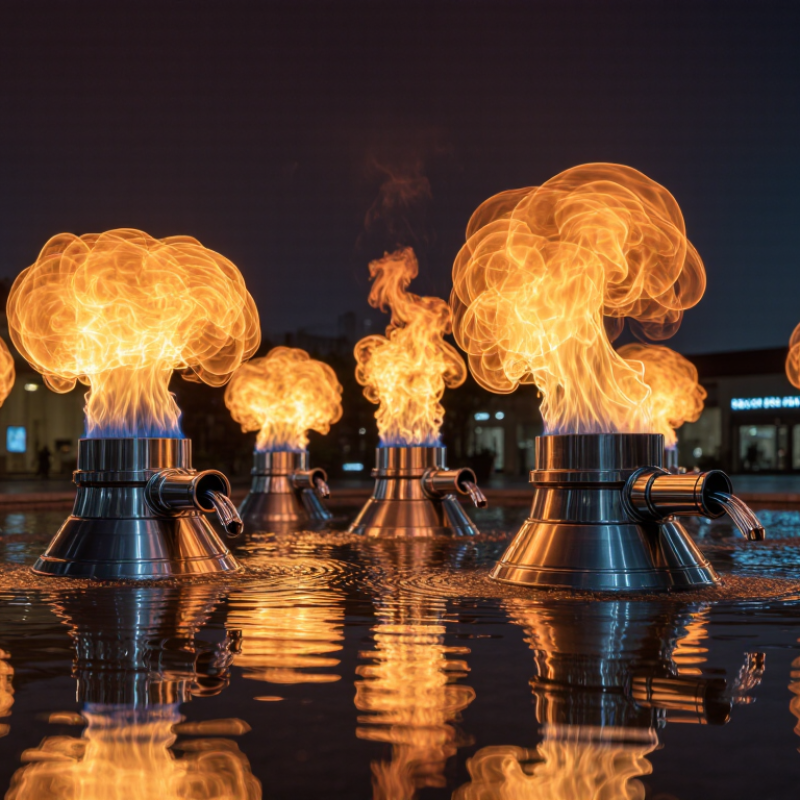
7 Best Fire Ball Fountain Nozzles for Commercial Projects
Understanding Fire Ball Fountain Nozzles in Commercial Design
Fire ball fountain nozzles are design components, not decorative add-ons. Their performance depends on gas pressure, orifice size, flame height, wind exposure, and basin geometry. In commercial projects, engineers should specify stable combustion before chasing dramatic visuals. The best nozzle creates a controlled flame with predictable heat distribution and a clean service path.
NFPA’s Fire Loss in the United States During 2023 reported approximately 1.39 million fires and nearly 3,800 civilian deaths. That data does not describe fountain systems directly, but it reinforces a critical principle: visible flames require disciplined risk management. Each installation should include approved fuel controls, automatic flame failure protection, emergency isolation, ventilation, and clear maintenance access. Local fire authorities must review the complete assembly.
Field experience also reveals a common weakness. Designers often select nozzles by flame height alone. That approach can ignore wind turbulence around towers, doors, and roof edges. A lower flame may perform better in real conditions. The International Building Code and applicable fuel-gas standards should guide clearances, materials, and equipment placement. Test the nozzle under cold starts, gusts, rain, and repeated ignition cycles. Some specifications look excellent on paper. They can still fail during a busy evening event. A practical design leaves room for adjustment, inspection, and honest reconsideration.
Typical design-reference values for commercial fire ball fountain nozzles. The comparison focuses on approximate flame height at the recommended operating flow rate; final sizing should be verified by a qualified fire-system engineer.
Design insight: High-output and cluster nozzles generally provide the greatest flame height, while low-profile and adjustable nozzles offer better control for installations with tighter architectural or safety constraints.
Commercial nozzle selection should begin with measured performance, not appearance. The U.S. Department of Energy’s Improving Pumping System Performance sourcebook reports that pumping systems can represent about 25% of industrial electricity use. A poorly matched nozzle may increase pressure demand, noise, and operating cost. Test each candidate at the project’s actual flow rate, pressure, spray height, and duty cycle. Small differences matter.
Look for stable discharge, clean spherical formation, and minimal splash outside the basin. Record flow variation over repeated tests. A nozzle that performs well for ten minutes may fail after eight hours. Check the orifice with calibrated gauges and inspect the water pattern under wind conditions. Real sites are rarely perfect. Sediment, scale, and uneven pressure can expose weak designs quickly.
Material selection deserves equal attention. Stainless alloys resist corrosion, but alloy grade, weld quality, and water chemistry still matter. ASTM B117 salt-spray testing can compare coatings, yet it does not predict exact outdoor service life. Ask for test duration, dimensional records, and maintenance results from comparable installations. DOE guidance also supports evaluating pumping efficiency across the operating range, rather than choosing one best-looking pressure point. I would question any supplier offering only polished photographs. For projects with separate flame effects, heat shielding, emergency controls, and local code review must be assessed independently.
Commercial fountain designers can choose seven fire ball fountain nozzle types for different visual and hydraulic goals.
A single-orifice jet creates a tall, focused flame-like water column. A multi-orifice cluster produces a fuller fireball effect above the basin. A ring nozzle forms a circular curtain, suitable for central plaza displays.
A dome nozzle spreads water evenly, creating a soft, glowing sphere. A fan nozzle creates a broad silhouette for wider viewing angles. A cascade nozzle adds layered movement and stronger foreground texture. An adjustable nozzle supports seasonal tuning when wind or water pressure changes.
Performance depends on more than appearance.
The U.S. Department of Energy reports that buildings consume about 40% of U.S. energy, so efficient pumps and controls deserve attention. The U.S. Environmental Protection Agency reports that household leaks waste nearly one trillion gallons annually nationwide. Commercial systems also need strict leak inspection and recovery planning.
NFPA 160 provides guidance for flame effects before audiences, including separation, supervision, and emergency controls. Qualified engineers should verify local requirements before installation.
Real sites are rarely perfect. Wind can distort a beautiful pattern. Mineral deposits can narrow small outlets. A practical specification should record flow rate, operating pressure, basin depth, filtration needs, and maintenance access.
In my experience, the most dramatic nozzle is not always the most reliable choice. A quieter, adjustable design may serve a busy commercial plaza better.
7 Best Fire Ball Fountain Nozzles for Commercial Projects
Installation Requirements for Water, Gas, and Control Systems
Selecting a fire ball fountain nozzle requires more than checking flame height. Water quality, gas pressure, drainage, and control response must work together. Design the basin with filtration, overflow protection, and accessible isolation valves. Suspended particles can block small orifices and distort the flame. Provide adequate pump capacity, stable suction conditions, and protected electrical service for ignition and sensors.
Gas installation demands qualified engineering and documented commissioning. NFPA 54 requires suitable piping, shutoff devices, pressure regulation, and combustion safeguards. NFPA’s Fire Loss in the United States During 2023 reported 1,504,500 fires, showing why decorative systems still need serious risk controls. Use ventilation that prevents gas accumulation. Locate detection devices where real airflow conditions support reliable sensing. Do not trust assumptions.
Control systems should include emergency shutdowns, flame-failure detection, water-level interlocks, and manual override access. IEC 61508 principles can guide functional safety decisions, although the final design must follow local requirements. Field testing should simulate low water, lost flame, communication failure, and power interruption. It is easy to overlook restart behavior. That mistake deserves review.
Commissioning records should document nozzle alignment, gas pressure, ignition timing, sensor performance, and shutdown results. Keep clearances measurable, not estimated. A 2024 industry safety review may emphasize automation, but operators still need practical training. Experienced technicians should inspect the system before every public opening and after major maintenance.
| No. | Nozzle Configuration | Recommended Commercial Use | Typical Flame Diameter | Typical Water Flow | Typical Gas Requirement | Water-System Requirements | Gas-System Requirements | Control and Safety Requirements | Installation Notes |
|---|---|---|---|---|---|---|---|---|---|
| 1 |
Single Vertical Fireball Nozzle
Compact burner mounted at the center of a circular or square water basin.
|
Small commercial courtyards, hotel entrances, restaurant terraces, and feature pools. | 0.45–0.90 m | 25–60 L/min for the surrounding fountain feature | Approximately 15–35 kW thermal input; final gas flow depends on fuel type and burner design. | Dedicated filtered pump circuit, isolation valve, basin overflow, drain, and water-level sensor. Keep the flame outlet clear of direct water spray. | Rigid metallic gas piping, accessible manual shutoff valve, pressure regulation, leak testing, and a flame-failure safety shutoff. | Programmable controller or relay panel; emergency-stop circuit; flame monitoring; low-water interlock; automatic gas shutoff on fault. | Suitable for a minimum clear zone above the flame. Provide a stable non-combustible mounting plate and service access without entering the basin. |
| 2 |
Annular Ring Fireball Nozzle
Circular burner ring producing a broad, even flame envelope.
|
Hotel atriums, public plazas, resort pools, and large architectural water features. | 0.90–1.80 m | 60–160 L/min | Approximately 35–90 kW thermal input, subject to the approved burner and fuel specification. | Balanced water distribution, debris strainer, pump with variable-speed control, overflow protection, and separate water and gas service zones. | Manifolded gas supply with pressure monitoring, sectional isolation, corrosion-resistant fittings, and a listed automatic safety valve assembly where required. | Central programmable logic controller, flame supervision, gas-pressure switch, low-flow water switch, emergency stop, and controlled ignition sequence. | Ring burners require accurate leveling and even gas distribution. Allow access to the full ring for inspection and cleaning. |
| 3 |
Multi-Port Cluster Nozzle
Several compact burner ports arranged in a circular or linear cluster.
|
Layered fire-and-water compositions, retail developments, entertainment venues, and themed landscapes. | 0.75–1.50 m overall cluster effect | 40–120 L/min | Approximately 25–75 kW thermal input across the complete cluster. | Independent pump branch or balanced manifold, removable strainers, water-level control, drain-down capability, and splash containment. | Individual or zoned gas isolation, properly supported metallic pipework, pressure regulation, and flame supervision for the complete cluster. | Zoned ignition logic, flame-failure reset, water-flow permissive, maintenance lockout, and an emergency-stop circuit that closes the gas valves. | Port spacing must be coordinated with the flame envelope. Avoid placing combustible finishes, low branches, signage, or overhead fabric within the heat and flame clearance area. |
| 4 |
Low-Profile Basin Nozzle
Short, recessed burner assembly designed to minimize visual hardware.
|
Urban plazas, museums, premium developments, and installations where sightlines are important. | 0.35–0.75 m | 20–50 L/min | Approximately 12–30 kW thermal input. | Recessed equipment chamber with drainage, removable access cover, filtered recirculation, automatic refill or level monitoring, and protection against standing water around gas components. | Gas pipework should terminate outside the wet chamber whenever practicable. Use approved flexible connections only where permitted, plus isolation, regulation, and leak testing. | Flame detector, ignition controller, water-level permissive, chamber ventilation, access-door interlock where applicable, and remote emergency shutoff. | The burner must remain above the maximum operating water level. Design the basin so sediment and maintenance water cannot enter the gas train. |
| 5 |
High-Output Show Nozzle
Larger burner assembly intended for a prominent flame effect viewed from a distance.
|
Theme parks, event spaces, destination resorts, civic plazas, and large public spectacles. | 1.50–3.00 m | 100–300 L/min | Approximately 90–250 kW thermal input; requires project-specific combustion and fire-safety design. | Dedicated pump and filtration, high-flow piping, surge control, level sensors, overflow routing, and protection against wind-driven spray entering the burner. | Engineered gas train with pressure monitoring, automatic safety shutoff valves, venting where required, emergency isolation, and a complete commissioning test under operating conditions. | PLC or dedicated effects controller, flame supervision, wind-speed shutdown, gas-pressure monitoring, low-water protection, emergency stop, and fire-alarm interface where required by the authority having jurisdiction. | Perform a site-specific hazard assessment for flame height, radiant heat, wind, crowd distance, overhead obstructions, and nearby combustible materials. |
| 6 |
Linear Flame-Bar Nozzle
Extended burner slot creating a continuous or segmented line of flame.
|
Building edges, linear reflecting pools, stage surrounds, pedestrian promenades, and architectural walls. | 0.40–1.20 m flame height; 1–4 m typical length | 30–120 L/min | Approximately 25–100 kW thermal input depending on length and port density. | Linear basin with uniform water depth, debris filtration, sectional drain points, accessible pump isolation, and splash control along the full burner length. | Gas manifold divided into serviceable sections, pressure regulation, supported pipework, automatic safety valves, and adequate clearance from water-filled cavities. | Sectional flame monitoring, staged ignition, water-flow permissive, emergency stop, fault indication, and optional effects synchronization with lighting or music systems. | Provide thermal expansion allowance and precise alignment. Long burners should be divided into manageable service zones rather than treated as one inaccessible assembly. |
| 7 |
Wind-Resistant Enclosed Fireball Nozzle
Burner with a protective non-combustible enclosure or wind shield.
|
Open-air waterfronts, rooftop terraces, coastal developments, exposed plazas, and windy sites. | 0.60–1.50 m | 40–140 L/min | Approximately 30–100 kW thermal input, subject to enclosure ventilation and burner approval. | Protected basin, filtered recirculation, low-water cutoff, overflow and drain provisions, and water-spray control to prevent flame disturbance. | Ventilated non-combustible enclosure, accessible gas isolation, pressure regulation, automatic shutoff, and gas detection where required by the risk assessment or local regulations. | Flame supervision, wind-speed sensor, enclosure-temperature monitoring, low-water interlock, emergency stop, automatic restart lockout, and remote status indication. | Do not fully seal the enclosure. Combustion air, exhaust paths, heat dissipation, maintenance access, and wind-load calculations must be addressed by the project engineer. |
Maintenance affects both appearance and safety. Inspect nozzle openings for mineral deposits, blocked passages, corrosion, and damaged seals. Clean water filters regularly, especially in hard-water regions. Check flame behavior during scheduled inspections. Uneven flames may indicate contamination, pressure changes, or poor air balance. Small faults can become expensive failures. They should not be ignored. Keep inspection records with cleaning dates, replaced parts, test results, and observed weather conditions. This documentation supports dependable maintenance, although records alone cannot replace physical inspections.
The seven most useful nozzle styles may include adjustable flame, fixed vertical, wide crown, low-profile, wind-resistant, modular, and custom-engineered designs. Choose by basin size, viewing distance, wind exposure, water quality, fuel arrangement, and service access. A dramatic nozzle is not always the best commercial choice. I have seen projects select oversized flames, then struggle with heat management and cleaning access. That mistake is avoidable, but selection tables can oversimplify real sites. Request performance data under comparable conditions, confirm replacement availability, and leave enough clearance for technicians to work safely.
It is a design component for producing a controlled water and flame-like visual effect. Appearance is only one factor. Pressure, outlet size, wind, and basin shape affect performance.
Start with measured flow, pressure, spray height, and operating duration. Do not select a nozzle by flame height alone. A shorter effect may perform better near doors or tall buildings.
A single outlet creates a narrow, focused column. A clustered outlet creates a fuller spherical effect. Ring designs form circular curtains, while fan designs suit wide viewing areas. Adjustable models help manage seasonal wind changes.
Use approved fuel controls, automatic flame-failure protection, emergency isolation, and suitable ventilation. Provide clear inspection access. Local fire authorities should review the complete assembly before operation.
Wind turbulence can distort flames and water patterns. Roof edges, towers, and entrances may create sudden gusts. Test the nozzle during calm conditions and gusts. A dramatic pattern can still fail during a crowded evening event.
Test cold starts, rain, gusts, repeated ignition cycles, and extended operation. Record flow changes during repeated trials. Ten minutes of success proves very little. An eight-hour duty cycle may reveal clogging or pressure loss.
Inspect outlets for sediment, scale, corrosion, and uneven discharge. Check filters and basin cleanliness regularly. Small deposits can narrow openings and weaken the visual effect. Leave space for tools and safe inspection.
Stainless materials resist corrosion, but performance depends on alloy, weld quality, and water chemistry. Coating tests provide useful comparisons, not exact service-life predictions. Ask for dimensional records and comparable maintenance evidence. Polished photographs are not enough.
It can help compensate for changing wind, pressure, and seasonal conditions. Adjustability may also reduce unnecessary pumping demand. However, it adds components and maintenance points. I would still question whether the extra flexibility is truly needed.
Choosing the right Fire Ball Fountain Nozzle is essential for creating a reliable, visually striking feature in commercial environments. This guide explains how these nozzles shape flame and water effects, while highlighting the performance factors that matter most, including flame consistency, water flow control, corrosion resistance, material quality, energy efficiency, and long-term durability. It introduces seven nozzle types suited to different project goals, from compact decorative installations to large-scale architectural water features.
The article also outlines key installation requirements for water supply, fuel delivery, ignition, ventilation, electrical controls, drainage, and emergency shutoff systems. Proper coordination between these systems helps ensure stable operation and easier servicing. Finally, it covers routine inspection, cleaning, professional maintenance, and site-specific selection based on weather exposure, pool dimensions, viewing distance, operating schedules, and local safety requirements. With careful planning and responsible installation, commercial designers can achieve an attractive, maintainable, and dependable fire-and-water display.