Hydraulic Engineering & Physics Jumping Jet Fountain Nozzle: Precision Engineering, Fluid Mechanics & Global B2B Procurement
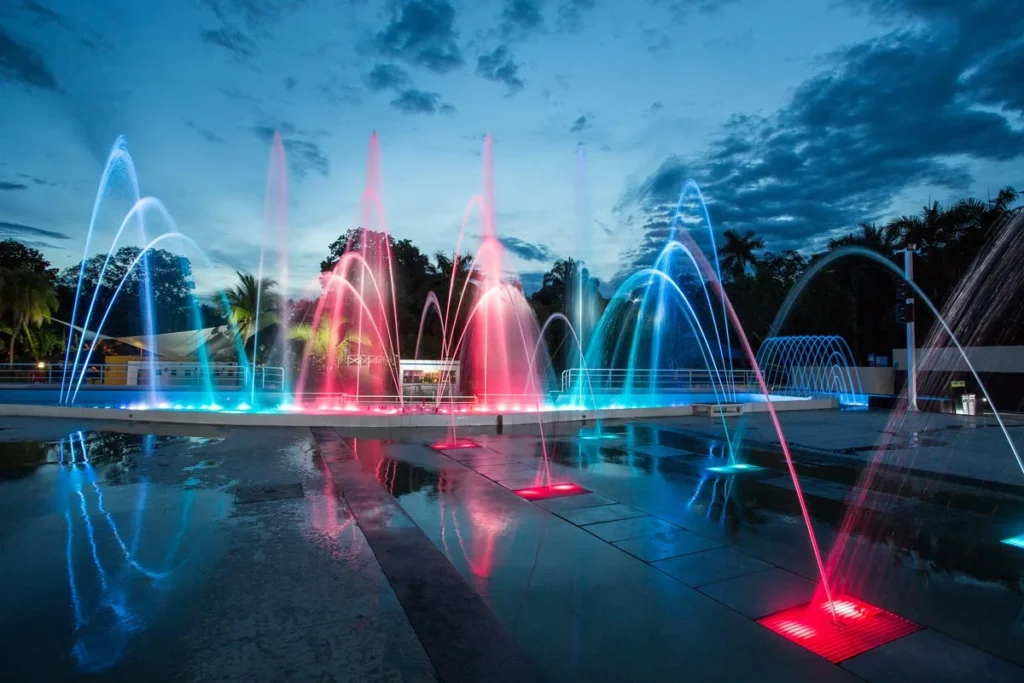
In contemporary architectural landscape design and municipal water show engineering, few visual elements captivate public audiences quite like the Jumping Jet Fountain Nozzle. Unlike conventional fountain jets that produce turbulent, misty, or aerated spray patterns, a jumping jet outputs a perfectly continuous, crystal-clear, non-turbulent cylinder of water resembling a flexible glass rod. When paired with high-speed internal cutting solenoids and integrated fiber-optic RGBW LED illumination, this smooth stream can be instantaneously chopped into discrete, glowing liquid rods that "leap" through the air from one basin to another.
Understanding the Fluid Dynamics Behind Jumping Jets
To appreciate how a Jumping Jet Fountain Nozzle achieves its mesmerizing visual clarity, one must analyze the underlying principles of fluid dynamics—specifically the transition from turbulent flow to laminar flow controlled by the Reynolds Number ($Re$). In standard pipe hydraulics, water moving at elevated velocities experiences internal friction, vortex shedding, and boundary-layer separation. This turbulence causes the exiting stream to break apart into random droplets, creating aerodynamic drag and visual distortion.
Our engineering team at Symphony Fountains in Vadodara, India, designs internal nozzle chambers equipped with multi-stage flow rectifiers, stainless steel micro-mesh settling screens, and pressure-equalizing conical diffusers. These components systematically strip out micro-vortices, reducing the internal Reynolds Number below the critical threshold ($Re < 2100$). As a result, the water molecules travel in parallel layers without lateral mixing, maintaining surface tension integrity even across horizontal arcs exceeding 8 meters in length.
Multi-Stage Flow Rectification
Passes pressurized water through precision brass honeycomb structures to realign chaotic fluid vectors into aligned linear streamlines.
High-Speed Solenoid Chopper
Executes millisecond-level mechanical cuts using pneumatic or high-frequency electromagnetic actuators without disturbing the laminar core.
Total Internal Reflection (TIR) Optics
Couples high-intensity RGBW LED light directly into the laminar water core, converting the stream into an underwater light pipe (fiber optic effect).
Anatomy of an Industrial-Grade Jumping Jet Nozzle
Procuring high-performance fountain hardware requires an in-depth understanding of material specifications and internal mechanical assemblies. A commercial jumping jet nozzle manufactured by Symphony Fountains comprises several critical subsystems engineered for decades of maintenance-free operation:
- Outer Shell & Mounting Chassis: Heavy-duty AISI 304 or AISI 316L stainless steel housing with multi-axis alignment swivels, enabling precise pitch ($0^\circ - 45^\circ$) and azimuth ($360^\circ$) adjustment on site.
- Laminar Stabilization Chamber: A pressure-tested pressure vessel containing fine-mesh stainless steel baffle plates that dampen pump pulsations and eliminate micro-bubbles.
- Internal Pneumatic / Electric Water Cutter: A high-durability blade mechanism capable of executing up to 20 cuts per second (15ms action speed), allowing programmers to create tiny liquid bullets or long arching water segments.
- Direct-Coupled Submersible Light Engine: A fully pot-sealed, IP68-rated DMX512-controllable RGBW LED fixture positioned behind the optical glass window at the focal axis of the nozzle orifice.
- Internal Drainage & Bypass Port: Directs water diverted during the cut cycle back into the surrounding pool basin without creating surface splash or disturbing the primary stream trajectory.