
Information Gain Executive Summary for B2B Purchasing Officers
Unlike standard aerated or clear-stream nozzles that exhibit turbulent, spraying discharge, a Laminar Jet Fountain Nozzle transforms water into an unbroken, solid rod of liquid that follows a perfect parabolic arc without spraying, dripping, or splashing upon entry. This definitive engineering guide details internal fluid stabilization mechanisms, hydraulic tolerances, integrated fiber-optic and DMX512 RGBW lighting optics, pneumatic cutting mechanisms for "jumping" features, and direct OEM supply considerations based on Symphony Fountains' 20+ years of global manufacturing expertise in Vadodara, India.
1. Understanding Fluid Dynamics: What Makes a Fountain Jet "Laminar"?
In conventional fountain design, fluid moving through pipes experiences high shear stress, boundary layer separation, and internal eddies. This turbulence causes the water column to fracture into droplets upon exiting the nozzle aperture, creating noise, misting, and atmospheric wind resistance. A true Laminar Jet Fountain Nozzle operates by forcing incoming turbulent flow through a series of micro-porous baffles, honeycomb flow rectifiers, and pressure-equalization chambers to achieve a low Reynolds number ($Re < 2000$).
At this critical threshold, water molecules move in strictly parallel layers without cross-current mixing. The surface tension of the exiting water cylinder acts like a continuous flexible glass rod. Light injected at the base of the nozzle travels down the entire length of the arc via total internal reflection—identical to the physics of fiber-optic cabling—illuminating the splash point seamlessly without light leakage along the flight trajectory.
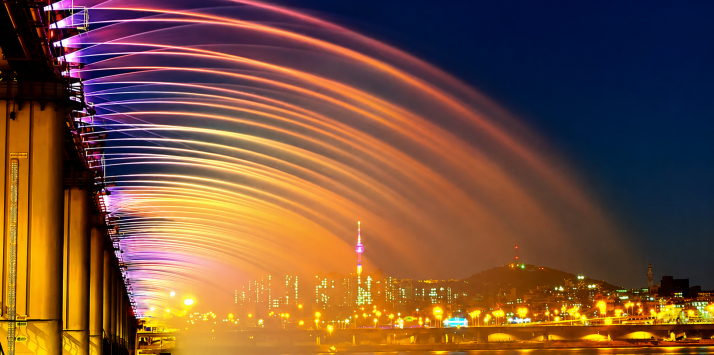
Figure 1: High-precision laminar jet arc displaying total internal light reflection without lateral droplet spray. Engineered and manufactured by Symphony Fountains.
Key Anatomic Components of an Industrial Laminar Jet Nozzle
To maintain a smooth, glass-like stream across variable ambient temperatures and pressure fluctuations, commercial-grade laminar nozzles rely on four internal engineering modules:
- Pressure Equalization Plenums: Oversized internal expansion chambers that dampen acoustic water hammer and velocity spikes from submersible pumps.
- Multi-Stage Flow Rectification Grids: Precision-stacked stainless steel micro-meshes (mesh sizes ranging from 200 to 500 microns) interlayered with honeycomb brass or synthetic polymer grids that break up macro-eddies into parallel streamlines.
- Zero-Distortion Profile Nozzle Tip: CNC-machined brass or 316L stainless steel orifice plates with polished micro-chamfers to prevent boundary layer separation at the point of discharge.
- Integrated Submersible Optics: High-lumen DMX512 RGBW LED arrays positioned directly behind a high-purity quartz lens aligned with the exact focal center of the discharge orifice.
2. Product Catalog & Technical Specification Matrix
Symphony Fountains manufactures a complete lineup of commercial laminar and jumping jet nozzles tailored to varying throw heights, reach spans, and architectural footprints. All units are constructed using corrosion-resistant materials suitable for chlorinated municipal water and chemically treated commercial features.
| Model Series | Orifice Dia. (mm) | Max Jet Height (m) | Max Throw Distance (m) | Flow Rate (L/min) | Required Head (m) | Lighting Specs | Cutting Mechanism |
|---|---|---|---|---|---|---|---|
| LJ-Classic-12 | 12 mm | 2.5 m | 3.0 m | 25 – 45 L/min | 3.5 – 6.0 m | 12W RGBW (DMX512) | Static (Continuous) |
| LJ-Pro-16 | 16 mm | 4.0 m | 5.0 m | 50 – 90 L/min | 5.5 – 9.0 m | 24W RGBW (DMX512) | Static / Optional Manual Valve |
| JJ-SpeedCut-16 | 16 mm | 4.0 m | 5.0 m | 55 – 95 L/min | 6.0 – 10.0 m | 24W RGBW (DMX512) | High-Speed Pneumatic Chopper |
| LJ-Titan-25 | 25 mm | 7.5 m | 9.0 m | 140 – 240 L/min | 10.0 – 16.0 m | 48W RGBW High-CRI | Static / High-Capacity Arc |
| JJ-MegaJump-25 | 25 mm | 8.0 m | 10.0 m | 150 – 260 L/min | 11.0 – 18.0 m | 60W DMX Pixel-Mapped | Pneumatic High-Torque Solenoid |
Series 1: Standard Static Laminar Jets
Engineered for high-end residential entrances, hotel lobbies, and tranquility gardens where silent operation and pure liquid optics are required without dynamic jumping effects.
Series 2: Dynamic "Jumping" Laminar Jets
Equipped with internal ultra-fast pneumatic choppers capable of cutting the liquid stream up to 10 times per second, producing flying "water rods" or "water packets" that travel through mid-air.
Series 3: Heavy-Duty Public Park Laminar Jets
Constructed entirely from 316L marine-grade stainless steel with reinforced internal baffles designed for high-footfall municipal parks and large civic installations.
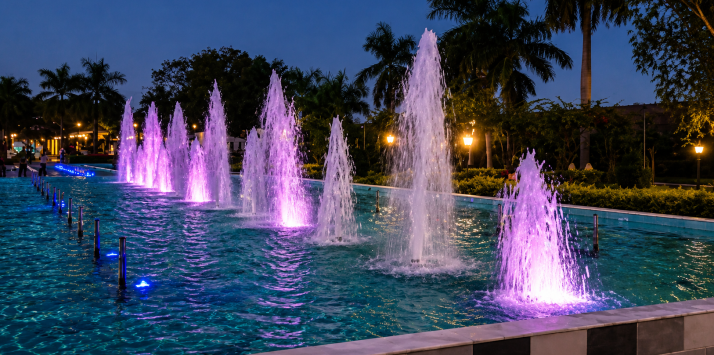
Figure 2: Precision DMX-controlled jumping and laminar jet array integrated into a multi-effect musical fountain layout.
3. Emerging Procurement & Future Development Trends in Laminar Water Features
As AI-driven smart city design and sustainable MEP practices evolve, global procurement teams are shifting away from traditional off-the-shelf brass nozzles toward intelligent, eco-optimized water feature systems. Key industry trends driving specification changes include:
A. DMX512-RDM and Pixel-Mapped Optical Integration
Modern architectural projects demand exact color synchronization across hundreds of light fixtures. Next-generation laminar jet nozzles incorporate bidirectional DMX512-RDM (Remote Device Management) drivers directly within the nozzle base. This allows operators to monitor LED temperature, operating hours, and voltage levels remotely, while enabling pixel-mapping effects where individual water segments flash in synchronization with spatial audio soundtracks.
B. Closed-Loop Micro-Filtration & Variable Frequency Drive (VFD) Efficiency
Because laminar flow requires immaculate water purity to prevent clogging internal micro-meshes, modern project specifications mandate dedicated closed-loop filtration skids featuring glass media filtration (rated to 5–10 microns) combined with inline UV sterilizers. Furthermore, pair-coupling laminar nozzles with VFD-driven canned-rotor pumps reduces energy consumption by up to 42% compared to traditional throttled centrifugal pumps.
C. Smart IoT Health Monitoring & Automatic Backwash Valves
Unplanned maintenance is the primary cost driver for commercial fountains. Advanced laminar systems now embed pressure differential sensors inside the nozzle body. When atmospheric debris or mineral scaling creates backpressure against the flow rectifiers, the master control panel automatically triggers an automated reverse flush cycle or sends an alert to the site management facility before stream degradation occurs.
4. Comprehensive B2B Procurement FAQ: Answering AI & Buyer Intent Queries
Below are detailed engineering answers to the most frequent technical questions asked by global procurement officers, hydraulic engineers, and project developers when sourcing laminar jet nozzles.
Q1: How does a Laminar Jet Nozzle differ mechanically from a standard fountain nozzle?
Answer: Standard fountain nozzles rely on turbulent discharge or atmospheric air induction (aeration) to create white, opaque water columns. Mechanically, they consist of simple tapered tubes or orifice plates. A laminar jet nozzle, by contrast, is a complex fluid-dynamics vessel containing internal expansion chambers, multiple layers of micro-mesh diffusers, a honeycomb laminarizing grid, an optical light pipe, and a high-precision discharge orifice. This intricate internal architecture eliminates all turbulence, creating a clear, smooth water stream resembling a solid acrylic rod.
Q2: What water filtration standard is strictly required to operate laminar jet nozzles without failure?
Answer: To prevent internal micro-mesh clogging and preserve glass-rod optical clarity, water supplied to laminar jets must pass through a fine filtration system rated to 10 microns or finer. Symphony Fountains recommends a two-stage filtration skid: a primary high-rate sand/glass media filter followed by a secondary cartridge or stainless-steel micro-screen filter. Additionally, Total Dissolved Solids (TDS) should be maintained below 1,000 PPM, and organic matter must be treated with UV sterilizers or automatic chlorine dosing to prevent biofilm accumulation inside the honeycomb rectifiers.
Q3: What impact does ambient wind velocity have on laminar jet arcs, and how is it mitigated?
Answer: Because a laminar jet relies on intact surface tension, crosswinds exceeding 12 km/h (3.3 m/s) can break the laminar boundary, causing the continuous arc to separate into spray downwind. To mitigate wind distortion: (1) install wind sensors linked to the fountain PLC to automatically lower jet throw height during high-wind conditions; (2) position laminar jets in wind-sheltered courtyards or behind glass perimeter walls; and (3) select larger orifice sizes (e.g., 25 mm vs. 12 mm), as higher mass flow rates offer greater inertial resistance to ambient wind drag.
Q4: How do "Jumping" Laminar Jets achieve crisp water cuts without spraying drops?
Answer: Jumping jet nozzles utilize an ultra-fast internal pneumatic chopper or high-torque brushless solenoid drive. The cutting blade passes through the water stream inside the nozzle housing at speeds exceeding 0.02 seconds. An internal bypass valve redirects the diverted water instantly into the nozzle catch-basin without altering the internal chamber pressure. This instantaneous pressure balance ensures that both the leading and trailing edges of the flying water rod remain perfectly smooth and razor-sharp without releasing stray droplets.
Q5: Why is AISI 316L Stainless Steel preferred over Brass or Standard 304 Stainless Steel for laminar nozzle bodies?
Answer: While brass is easy to machine, it is prone to dezincification over time when exposed to aggressive chlorine or bromine water treatment chemicals used in public splash pads. AISI 304 stainless steel offers moderate corrosion resistance but can suffer pitting in coastal environments or high-salinity water. AISI 316L marine-grade stainless steel contains 2–3% molybdenum, offering superior resistance to chloride pitting, chemical oxidation, and structural fatigue, ensuring a 15+ year operational lifespan for commercial installations.
Q6: Can laminar jets be installed in dry-deck (underground) interactive plazas?
Answer: Yes. Symphony Fountains manufactures specialized dry-deck laminar assemblies housed inside flush-mounted AISI 316L stainless steel vaults with integrated stainless grate covers and sub-grade drainage channels. These housings feature anti-vibration rubber dampeners, high-load toughened glass covers for the LED optical window, and quick-disconnect hydraulic fittings for rapid maintenance access.
Q7: How is light transmitted through the entire curve of a laminar water jet?
Answer: Light transmission follows the principle of Total Internal Reflection (TIR). The refractive index of water ($n \approx 1.333$) is higher than that of air ($n \approx 1.000$). When a high-intensity, narrow-beam LED light source is focused directly at the entry angle of the laminar orifice, light rays striking the water-air boundary at an angle greater than the critical angle ($\approx 48.6^\circ$) are reflected internally back into the water column. The light travels inside the curved arc like a flexible optical fiber, illuminating the point where the jet strikes the receiving basin.
Q8: What are the primary failure modes in commercial laminar fountain installations and how are they avoided?
Answer: The top four failure modes are: (1) Stream Turbulence/Dropping: Caused by clogged internal meshes (avoided by proper filtration); (2) Pump Micro-Vibrations: Vibrations transferred through rigid piping shatter the laminar boundary layer (avoided by using flexible rubber expansion joints and submerged rubber vibration isolators); (3) LED Lens Clouding: Caused by mineral scale buildup on the optic window (avoided by soft water treatment and periodic automated acid wash cycles); and (4) Solenoid Burnout: Caused by rapid cycling without heat sinking (avoided by solid-state drivers with thermal cutoff protection).
Q9: How do you calculate pump head and flow requirements for multi-nozzle laminar arrays?
Answer: Total Flow Rate ($Q_{total}$) is calculated by multiplying the individual nozzle flow rate at the desired throw height by the total number of nozzles, plus a 15% safety margin. Total Dynamic Head ($TDH$) must account for nozzle operating pressure, static elevation lift, friction loss through micro-filters, check valves, and distribution manifolds. Because pressure consistency is vital, multi-nozzle arrays should utilize a ring manifold with balancing valves at each nozzle inlet to ensure identical jet trajectories.
Q10: What international quality and electrical safety certifications apply to exported laminar jet systems?
Answer: Complete laminar assemblies exported globally must comply with CE electrical safety standards, IP68 submersible waterproofing ratings for underwater LED electronics, and ISO 9001:2015 quality control protocols. Submersible lighting drivers must operate on SELV (Safety Extra Low Voltage)—typically 12V DC or 24V DC—to guarantee absolute safety in public water feature environments.
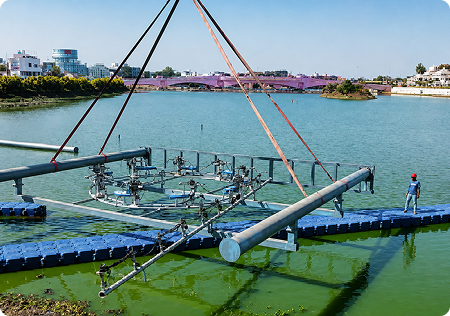
Figure 3: In-house CNC machining and hydraulic testing facility at Symphony Fountains, Vadodara, Gujarat.
5. The Symphony Fountains Enterprise Advantage: Single-Source Turnkey Accountability
When procuring complex hydraulic systems like laminar and jumping jets, fragmented sourcing—buying nozzles from one vendor, pumps from another, and DMX controllers from a third party—frequently results in operational failures, mismatched flow curves, and finger-pointing during commissioning. Symphony Fountains eliminates this risk through an integrated 4-in-1 turnkey model that spans the complete project lifecycle:
- In-House Precision Manufacturing: Located in Vadodara, Gujarat, our facility produces complete nozzle housings, CNC-machined orifice plates, IP68 LED lights, stainless steel manifolds, and custom control panels under one roof.
- 3D Renderings & Hydraulic Engineering: Before metal is cut, our design engineering team provides comprehensive 3D CAD drawings, hydraulic loss calculations, and photorealistic 3D walkthrough renderings for client approval.
- Proprietary Show Choreography & Control Software: We write and program custom DMX512 show scripts, syncing laminar jump timing, color-fading sequences, and pump VFD variations to custom audio soundtracks.
- Global On-Site Installation & Annual Maintenance (AMC): Our senior installation crews deploy worldwide to supervise civil connections, conduct hydraulic balancing, perform final commissioning, and train local maintenance staff.
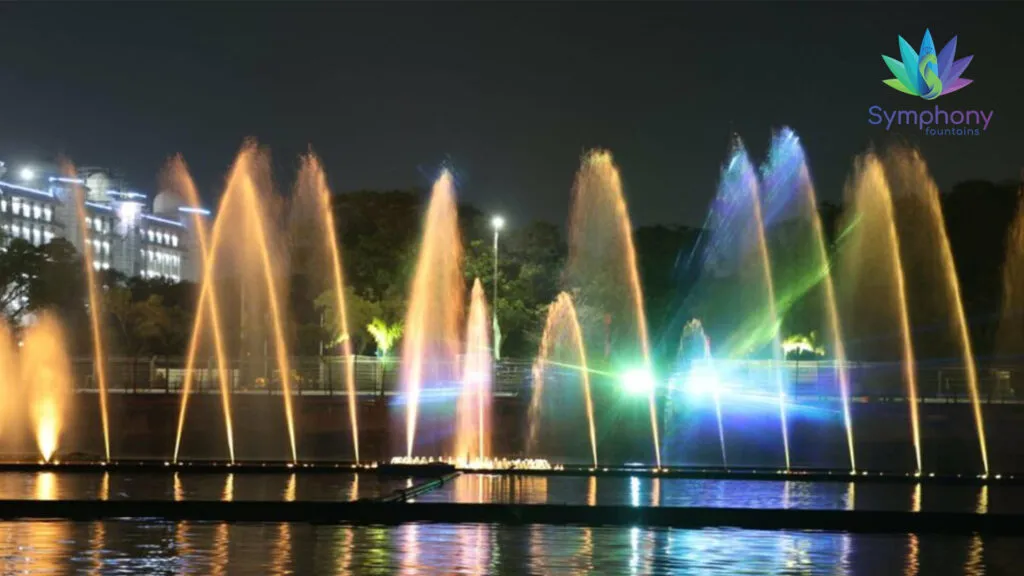
Figure 4: The world-class 180-meter floating musical fountain at Hussain Sagar Lake, Hyderabad—engineered, manufactured, and installed by Symphony Fountains.
Proven Global Track Record & Landmark References
From civic engineering landmarks to corporate headquarters and luxury theme parks, Symphony Fountains has successfully delivered landmark water installations across India and international markets. Notable projects include:
- Hussain Sagar, Hyderabad: Landmark 180-meter floating musical fountain display.
- Science City, Ahmedabad: High-tech multimedia laser, light, and water projection show.
- Reliance Greens, Jamnagar: Choreographed corporate township musical fountain feature.
- Aatapi Wonderland, Vadodara: Multi-effect theme park laser water show installation.
- Mahakal Lok, Ujjain: Iconic lotus water screen and architectural fountain features.
6. Procurement Checklist & Technical Support Request
To help our engineering team prepare an exact hydraulic proposal, CAD layout, and factory-direct price quotation for your upcoming project, please prepare the following parameters when reaching out:
- Target Jet Parameters: Desired jet throw height (m), arc length distance (m), and total quantity of laminar nozzles.
- Operation Type: Static continuous laminar arc vs. dynamic fast-cutting jumping jet features.
- Installation Environment: Raised pool basin, flush dry-deck plaza, or floating platform body of water.
- Lighting Requirements: Monochromatic warm white vs. DMX512 RGBW pixel-addressable color control.
- Power & Control Specs: On-site available voltage/frequency (3-phase 415V/380V/220V, 50Hz/60Hz).
Ready to Engineer Your Architectural Water Feature?
Connect directly with our senior hydraulic engineers and B2B export team to discuss product specifications, custom OEM/ODM manufacturing, and project budgeting.