
SymphonyFountains A Submersible Fountain Pump may look simple beside a pond or fountain basin, but its performance depends on flow rate, lift height, power consumption, and water conditions. For buyers comparing Chinese manufacturers, these details matter more than a product photograph or a headline price. The U.S. Department of Energy’s Improving Pumping System Performance: A Sourcebook for Industry notes that pumping systems use a significant share of global electricity. That figure covers pumping systems broadly, not decorative fountain pumps alone. Small details matter.
This guide introduces ten Chinese manufacturers and offers a practical starting point for comparison. It considers product range, published specifications, customization options, quality-control information, and export experience where available. A pump rated for a shallow garden feature may not suit a tall fountain with a long pipe run. Buyers should check the stated flow at the required head, along with materials, cable length, and service support. These points can be easy to overlook.
Company rankings are not universal, and public information can vary in depth. A polished catalog does not prove long-term reliability; independent testing and clear technical documentation provide stronger evidence. The list should therefore be treated as a research shortlist, not a final endorsement. Some gaps may remain, particularly where manufacturers disclose limited operating data. Comparing specifications directly and asking focused questions can help buyers identify a suitable supplier for their installation.
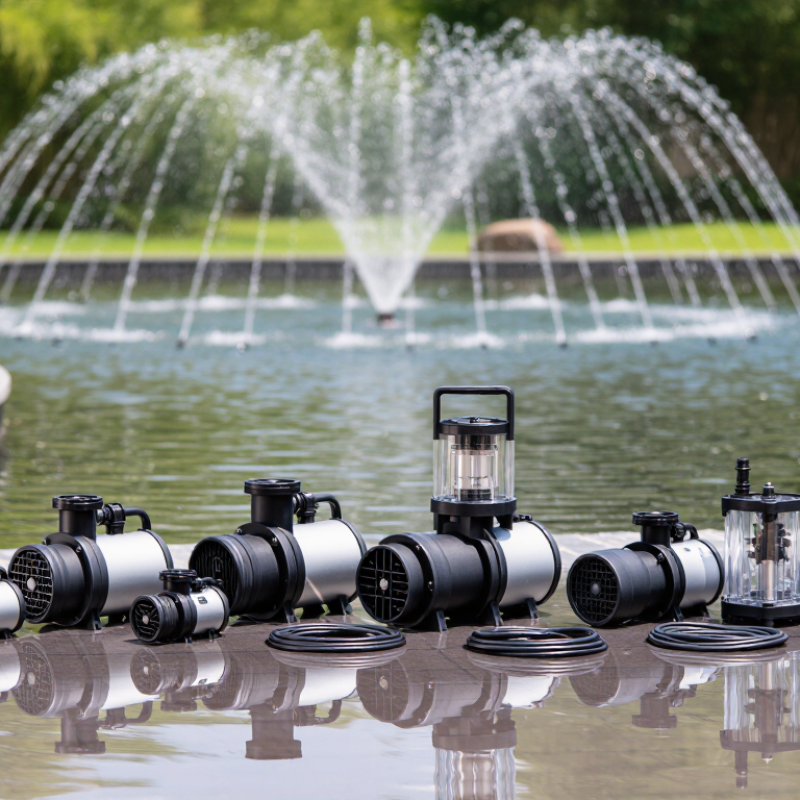
A submersible fountain pump sits underwater and pushes water through an outlet to create a jet, cascade, or bubbling display. Inside its sealed housing, an electric motor spins an impeller. Water enters through a screened intake, gains pressure, and travels up a connected tube or nozzle. Water does the cooling. The pump must remain submerged to avoid overheating and noisy operation.
Pump selection involves more than matching a quoted flow rate. Nozzle height, pipe length, bends, and filter buildup all affect the water that actually reaches the fountain. The U.S. Department of Energy’s Improving Pumping System Performance guide reports that pumping systems can consume 25–50% of electricity in some industrial facilities. That figure is not specific to fountains, but it shows why efficient operation and proper sizing matter. A pump that is too powerful may splash water out of a small basin; one that is undersized can produce a weak, uneven stream. Small details matter. Even the intake position can change performance.
Tips: Keep the intake clear of leaves and grit, and check that the water level covers the pump. Measure the lift from the water surface to the nozzle, not just the tube length. A little trial and adjustment is often necessary.
China’s submersible fountain pump industry draws on a broad network of motor, seal, cable, and plastic-component suppliers. This concentration can help manufacturers coordinate production and offer different flow rates, lift heights, and outlet configurations. A pump designed for a shallow garden basin may need different impeller clearance from one used in a deeper display pool. Small details matter. Material selection also affects service life, especially when pumps run for long hours or encounter mineral-rich water.
Manufacturing capability varies between factories. Some focus on standardized models, while others support custom voltage, cable length, or connection options. Buyers can assess a supplier by reviewing performance curves, insulation and leakage-test procedures, sample consistency, and spare-part availability. Ask how flow changes with lift height; a headline rating alone may not describe real installation performance. Not every specification tells the whole story. Documentation may be incomplete, and sample results can differ from later batches, so clear acceptance criteria are useful. Factory visits or independent inspections can provide additional evidence, but neither replaces testing under the intended operating conditions.
Industry overview across 10 practical comparison dimensions. This table does not rank or identify individual manufacturers; specifications vary by model, and product datasheets should be checked before selection.
| No. | Comparison Dimension | Industry or Technical Context | What Buyers Should Verify |
|---|---|---|---|
| 1 | Product scope | Submersible fountain pumps move water while operating underwater and are used in decorative fountains, ponds, and water features. | Confirm the pump is designed for the intended application, duty cycle, water conditions, and installation depth. |
| 2 | Flow rate and head | Flow rate and total head are linked operating characteristics. A pump’s delivered flow generally decreases as the required head increases. | Request the pump curve, and check the flow available at the actual system head—not just the maximum flow or maximum head listed separately. |
| 3 | Electrical supply | China’s standard mains frequency is 50 Hz; nominal low-voltage supply commonly includes 220 V single-phase and 380 V three-phase systems. | Match voltage, phase, frequency, plug or wiring arrangement, and motor rating to the destination installation. |
| 4 | Motor and duty rating | Small fountain pumps are commonly offered with single-phase motors; motor design and permitted operating duty depend on the model. | Check rated input or output power, continuous-duty suitability, thermal protection, and any restrictions on dry running. |
| 5 | Ingress protection | IP codes are defined by IEC 60529. An IPX8 marking concerns protection against immersion under conditions agreed for the equipment; the marking alone does not specify a universal depth or duration. | Ask for the stated immersion conditions and confirm that the complete pump and cable-entry arrangement meet the installation requirements. |
| 6 | Wetted materials | Common pump construction materials include engineering plastics and stainless steel. Material choice affects corrosion resistance and suitability for different water conditions. | Identify the exact material grade for the housing, shaft, impeller, and fasteners; assess compatibility with treated, saline, or chemically conditioned water. |
| 7 | Seals and insulation | Submersible designs rely on electrical insulation and sealing to keep water away from live components. Seal configuration varies by product. | Review seal type, cable-gland construction, insulation class, leakage protection recommendations, and service or replacement guidance. |
| 8 | Solids handling and intake | Fountain pumps may use an intake screen or filter, while allowable particle size and clogging resistance are model-specific. | Check the maximum permitted particle size, filter access, cleaning procedure, and whether the pump is intended for clear water or debris-bearing water. |
| 9 | Quality and compliance documents | Applicable product-safety and environmental requirements depend on the product design and destination market. A certification claim should be supported by relevant documentation. | Request test reports, declarations, and certificates that match the exact model and target market; verify the issuing body and document scope. |
| 10 | Manufacturing and supply evaluation | Manufacturers may differ in product range, customization, testing, and export support. These capabilities cannot be reliably inferred from a general industry label. | Assess factory audit records, incoming and final inspection procedures, sample-to-production consistency, warranty terms, spare parts, and lead-time commitments. |
When assessing Chinese submersible fountain pump manufacturers, compare technical evidence rather than relying on catalog claims. Check rated flow, maximum head, power consumption, and operating depth against your fountain design. Ask for pump curves at several flow rates; a single maximum figure can be misleading. Details matter. Confirm whether the stated performance reflects continuous operation and the actual outlet size.
Construction and quality controls deserve equal attention. Review the materials used for the housing, shaft, seals, and cable, especially if the pump will run outdoors for long periods. Request information on ingress protection, insulation, temperature limits, and routine factory testing. Not always. A polished test sheet may describe a sample, not every production unit, so ask how inspections are recorded and defects handled. Clear answers are useful.
Evaluate the supplier’s engineering support, spare-parts availability, lead times, and ability to adapt connections or voltage specifications. If possible, compare a sample under realistic conditions: measure flow, listen for unusual vibration, and check for leaks after a sustained run. One test cannot predict years of service. Still, it can reveal gaps between written specifications and practical performance. Allow time for clarification; technical discussions can expose assumptions on both sides.
To keep this overview name-free, the ten profiles focus on distinct capabilities rather than verified company rankings. One Chinese manufacturer may specialize in compact pumps for garden fountains, with small housings suited to narrow basins. Another may focus on stainless-steel construction for installations exposed to water and weather. A third may produce lightweight plastic models for home ponds. A fourth may build higher-head units for taller water displays. Check the pump curve, not just the advertised wattage.
A fifth supplier may prioritize quieter operation, using balanced impellers and vibration-reducing mounts. A sixth may offer custom wiring, plugs, or packaging for private-label orders. A seventh may develop pumps compatible with low-voltage or solar-powered systems. An eighth may supply matched pump-and-nozzle sets, making installation simpler. A ninth may have experience preparing export orders and spare-part kits. A tenth may emphasize in-house assembly and routine flow testing. Useful details include test conditions, cable length, and continuous-duty limits.
These profiles describe possible strengths, not confirmed attributes of named factories. Ask for current product specifications, sample units, and written test records before comparing suppliers. A brief water test can reveal uneven flow or excess vibration. It is not a full quality audit, though. Supplier capabilities vary, and catalog claims deserve careful checking.
China Top 10 Submersible Fountain Pump Manufacturers
Comparing ten Chinese manufacturers is more useful when product details are matched to the fountain’s real demands. Check rated flow, maximum head, power use, outlet size, and whether flow can be adjusted. A pump that moves plenty of water at ground level may perform differently when pushing water through a tall nozzle. Look for sealed motor housings, corrosion-resistant materials, and thermal protection. These features matter in ponds, garden fountains, decorative pools, and small water displays. Quiet operation matters.
Manufacturer offerings can differ in more than price. Some focus on compact pumps for tabletop features, while others offer higher-capacity models for larger basins. Compare published flow at working height, not just the maximum figure on a product sheet. Also check cable length, filter access, spare-part availability, and warranty terms. Clear technical documentation is a useful sign of dependable support, though it cannot guarantee long service life. Real performance still depends on installation, water quality, and regular cleaning.
Tips: Match the pump to the nozzle and lift height, then leave room for flow adjustment. Remove leaves and grit from the intake regularly. A small oversight: buyers sometimes compare wattage alone, even though it does not show how much water reaches the fountain head.
This chart shows the ideal hydraulic power needed to raise 1 m³ of water per hour at different lift heights. Values are calculated using water density of 1,000 kg/m³ and gravitational acceleration of 9.81 m/s²; actual pumps require more input power because of efficiency losses.
Its motor spins an impeller inside a sealed housing. Water enters through a screened intake and moves through a tube or nozzle. The surrounding water helps cool the pump.
Yes. Keep the water level above the pump. Running it dry can cause overheating and noisy operation. Check the level regularly.
Consider the nozzle height, pipe length, bends, and filter condition. A pump that is too strong may splash water out of a small basin. An undersized pump may produce a weak stream.
It is the vertical distance from the water surface to the nozzle. Measure that distance, not just the tube length. Small measurement errors can matter.
Lift height, pipe bends, and a clogged intake can reduce flow. A headline rating alone may not describe performance in your fountain. Check the pump curve.
Review performance curves, test procedures, sample consistency, and spare-part availability. Ask how flow changes as lift increases. Documentation may be incomplete.
Stainless steel may suit exposed installations, while plastic models can be lightweight for home ponds. Material choice depends on water conditions and operating hours. It is not a guarantee of long service life.
Test it in conditions close to your planned installation. Watch the stream and listen for excess vibration. A brief water test helps, but it is not a full quality audit.
This article explains what a Submersible Fountain Pump is, how it moves water while operating beneath the surface, and the main components that support reliable circulation. It also introduces China’s fountain-pump manufacturing landscape, including common production capabilities, quality-control practices, and the factors that shape product development. To help readers assess suppliers, the article outlines practical criteria such as performance, materials, energy use, product range, customization, and after-sales support.
The article then presents profiles of ten Chinese manufacturers without focusing on brand promotion, followed by a comparison of their product features and typical applications. Readers can learn how pump capacity, lift height, durability, and operating requirements may vary across models, and how to match those characteristics to fountains in gardens, public spaces, and other water features. The overview is intended to support clear, informed comparisons when selecting a suitable pump.