
SymphonyFountains Choosing a 3D Digital Fountain Nozzle is not just a question of spray height. The nozzle shapes the display’s outline, droplet texture, and response to changing water pressure. A narrow jet may look crisp in a calm courtyard, yet lose definition when crosswinds push its stream sideways. Small details matter.
The U.S. Department of Energy’s Improving Pumping System Performance sourcebook estimates that pumping systems account for nearly 20% of global electricity use. That figure covers many applications, not fountains alone. Still, it is a useful reminder: nozzle selection should match the pump, not fight it. Flow rate, operating pressure, filtration, lighting, and maintenance access all affect the result. A dramatic pattern on a product sheet may require more pressure than the installed system can deliver.
This guide explains how to compare nozzle patterns, materials, and operating requirements using practical criteria. It also considers site conditions, including basin dimensions and prevailing wind, which are easy to overlook during early planning. Ask suppliers for tested flow-and-pressure data, installation guidance, and cleaning recommendations. Then verify performance with a trial where possible. Published specifications help, but they cannot fully predict a live display. That uncertainty deserves attention.
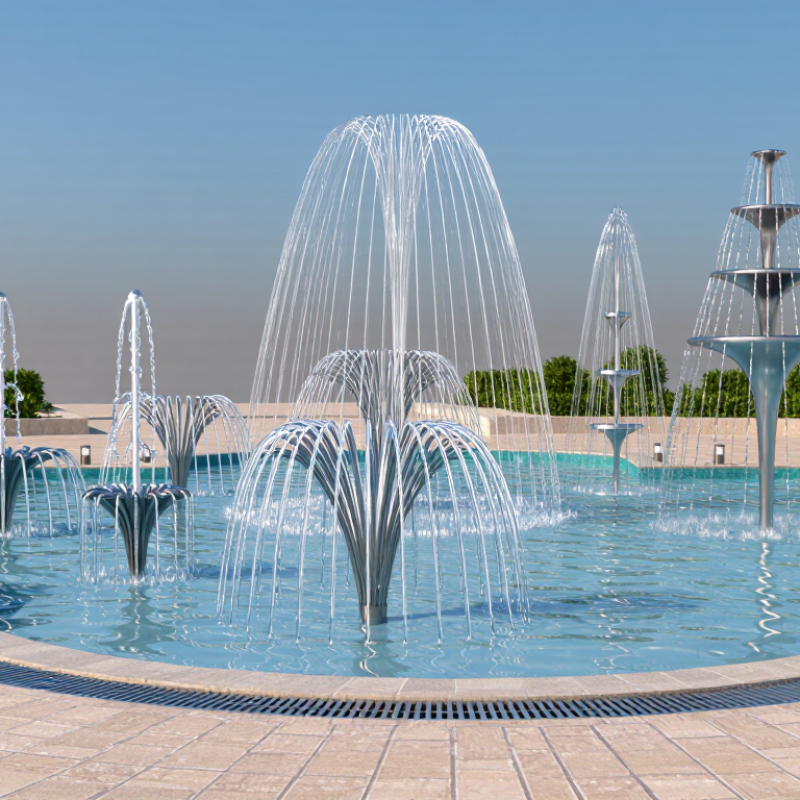
Choosing the best 3D digital fountain nozzle begins with defining the intended visual effect.
Do not start with nozzle size alone. Decide whether the display needs a solid vertical column, a twisting helix, a dome, or separated droplets. Each effect requires different control over flow rate, pressure, timing, and water recovery.
A narrow jet may appear sharp from the front but look weak from the side. Test the effect from every viewing angle.
The spray envelope is equally important.
It describes the nozzle’s full operating space, including height, width, droplet reach, and movement limits.
Measure the available basin area before selection. A nozzle producing a 2-meter arc can easily overspray a shallow tank. Wind and nearby lighting also change the result.
In practical installations, I have found that a calculated envelope still needs on-site adjustment. Real conditions are rarely perfect.
Tips:
How to Choose the Best 3D Digital Fountain Nozzle?
A digital fountain nozzle should be sized from measured flow, pressure, and fluid density. Use Q = C_d A√(2ΔP/ρ) for a practical first estimate. Here, Q is flow rate, A is nozzle area, and ΔP is pressure across the nozzle. The discharge coefficient, C_d, reflects contraction and internal losses. Water near room temperature has a density close to 1,000 kg/m³. Keep units consistent. A mismatch can produce a surprisingly large error.
Begin with the visual target. A narrow nozzle creates a sharper jet, while a larger opening produces more volume. Record the required flow in liters per minute, then convert it before using the equation. Measure pressure at the nozzle inlet, not only at the pump outlet. Tubes, filters, bends, and fittings consume pressure. They matter more than expected. I once treated outlet pressure as nozzle pressure, and my calculated jet was too strong.
The pump curve must support the selected operating point. Find the intersection between the pump curve and the system curve, then compare its flow with the calculated nozzle demand. Check performance at the highest and lowest expected water levels. A pump may reach the required pressure briefly, yet fail when several nozzles open together. Use a calibrated gauge and verify actual flow with a container and timer. Leave some pressure margin, but avoid excessive pressure that wastes energy and increases spray drift. Recheck the coefficient after testing; real nozzle geometry rarely behaves perfectly.
How to Choose the Best 3D Digital Fountain Nozzle?
Choose the nozzle at its design pressure, not its advertised maximum. Measure jet height from the outlet to the point where the stream visibly breaks. Record pattern width, edge stability, and center density. A tall jet is not automatically better. Excessive height can indicate unstable pressure or delayed breakup.
Use high-speed imaging to estimate droplet diameter and velocity. For example, test at 0.30 MPa, then repeat after thermal equilibration. Compare the median droplet size, not only the largest droplets. A narrow size distribution usually produces cleaner layers, while oversized droplets can create ridges and uneven curing. The 2024 Wohlers Report valued the global additive manufacturing industry at $20.035 billion in 2023, with 13.5% annual growth. That scale makes repeatable nozzle measurement increasingly important.
Pattern quality deserves equal attention. Photograph the spray on a calibrated surface at a fixed distance. Measure circularity, coverage, and satellite droplets. The 2024 IDTechEx analysis of additive manufacturing materials also emphasizes process control as a barrier to reliable production. In practice, a nozzle may show excellent height but poor coverage. I have seen this mistake during quick bench testing. The first spray looked impressive. It was not consistent. Check pressure stability, fluid temperature, and nozzle wear across at least three runs. Keep the imperfect result; it often reveals the real operating window.
How to Choose the Best 3D Digital Fountain Nozzle?
A 3D digital fountain nozzle should match your DMX512-A control plan, not only your water pressure system. One DMX512-A universe provides 512 data slots, commonly treated as 512 control channels. Each nozzle may need channels for height, direction, flow, dimming, color, and diagnostic feedback. Count every function before installation.
For example, a nozzle using 16 channels allows 32 units within one universe, leaving no spare capacity. That calculation looks efficient, but it is often too tight. Some controllers reserve channels for scenes, master intensity, or auxiliary pumps. I prefer leaving at least 10 percent unused. It makes troubleshooting less stressful. Addressing errors still happen.
Ask the supplier for a complete channel map and fixture profile. Confirm whether one channel controls one movement, a combined axis, or several preset effects. Test the nozzles at full output, because the DMX refresh rate can feel different when all 512 slots are active. Large installations may need multiple universes, separate data lines, or signal distribution equipment. Keep data cables away from pump power cables where possible. A short bench test can reveal unexpected channel overlap before water reaches the stage. My own planning mistake was counting physical nozzles instead of their actual channel footprints. That cost time, but it also showed why a simple addressing spreadsheet is essential.
Verify DMX512-A control needs against the 512-slot universe limit. The chart compares common generic control-profile sizes with the theoretical number of nozzles that one DMX512-A universe can address.
Calculation: maximum theoretical nozzle count = floor(512 DMX slots ÷ channels per nozzle). Real installations may support fewer units because of addressing gaps, control-console limits, cable topology, refresh-rate requirements, and reserved channels.
A 3D digital fountain nozzle should prove its performance beyond drawings and simulations. Test it in a full-scale basin, with the planned nozzle spacing and operating height. Measure jet shape, spray reach, and timing accuracy during repeated cycles. Small alignment errors can distort the pattern.
Wind response needs careful observation. Test under several wind speeds, including uneven crosswinds. Record drift at the nozzle, midpoint, and landing area. A jet may look stable near the outlet but scatter several meters away. Use calibrated anemometers and video footage from fixed angles. Water quality also matters. Check filtration, hardness, temperature, and visible particles before testing. Dirty water can block narrow passages and create inconsistent shapes.
Tips: Run the test for several hours, not only a few minutes. Inspect filters afterward. Compare real water use with design estimates. Test motion at slow, medium, and fast speeds. Listen for vibration and watch for delayed movement. Our first trial looked impressive, but the outer jets arrived late. That result exposed a control problem. No test is perfect. Leave time for adjustment.
Choose a nozzle after reviewing measured results, maintenance access, and repeatability. A reliable system should perform clearly when conditions become less than ideal.
Identify the required shape first. Choose a column, helix, dome, or separated droplets. Each pattern needs different pressure, timing, and flow control. View the effect from every angle. A narrow front view may look weak from the side.
A spray envelope describes the nozzle’s full operating space. It includes height, width, droplet reach, and movement limits. Measure the basin before selection. Mark the spray boundary with temporary markers. Keep every droplet inside the collection area.
Record height, diameter, flow rate, and pressure. Note the available maintenance space. Check nearby lighting and wind exposure. A two-meter arc may overshoot a shallow basin. Small pressure changes can distort the pattern.
One universe provides 512 data slots. A nozzle using 16 channels allows 32 units mathematically. That leaves no spare capacity. Reserve at least 10 percent for scenes, master controls, or auxiliary equipment. Simple arithmetic can still mislead.
Request a complete channel map and fixture profile. Confirm how movement, flow, color, and diagnostics use channels. Test whether one channel controls one axis or several effects. I once counted physical nozzles instead of channel footprints. That mistake cost time.
Drawings cannot reveal every alignment or timing problem. Test the planned spacing and operating height. Measure jet shape, spray reach, and repeated movement cycles. Small alignment errors become obvious in real water. Test slowly.
Test during several wind conditions, including uneven crosswinds. Record drift at the outlet, midpoint, and landing area. Use fixed-camera video and a calibrated wind meter. Check filtration, hardness, temperature, and visible particles. Dirty water can block narrow passages.
Run the system for several hours, not just a few minutes. Inspect filters afterward. Compare actual water use with estimates. Test slow, medium, and fast movement. Watch for vibration and delayed motion. Real conditions vary.
Choosing the best 3D Digital Fountain Nozzle begins with defining the intended visual effect, projection height, viewing angle, and spray envelope. These requirements determine the nozzle’s flow rate, pressure range, and water distribution. Use the equation Q = CᵈA√(2ΔP/ρ) to estimate flow, then compare the result with the pump curve to confirm that the system can deliver stable pressure under real operating conditions. At the design pressure, evaluate jet height, spray pattern, and droplet size to ensure the nozzle produces the desired three-dimensional appearance without excessive mist or uneven coverage.
Control and environmental performance are equally important. Confirm that the lighting and nozzle system fits within the 512-slot limit of a DMX512-A universe, or plan an appropriate control structure for larger installations. Before final selection, conduct a full-scale test that includes wind exposure, actual water quality, filtration conditions, and nozzle movement. This helps reveal pattern distortion, clogging risks, pressure fluctuations, and motion-related instability before installation.