 SymphonyFountains SymphonyFountains
 Choosing the best Digital Water Curtain supplier requires more than comparing photographs and quoted prices. A reliable decision connects visual performance, hydraulic engineering, electrical safety, maintenance, and verified project experience. The supplier should explain nozzle spacing, pump capacity, flow control, water filtration, lighting integration, and emergency shut-off procedures in clear technical language.
Market evidence also matters. Grand View Research reports continued growth in the global digital signage market, driven by interactive displays and immersive customer experiences. This trend increases demand for water-based media installations in malls, hotels, museums, and public venues. However, digital signage reports rarely separate Digital Water Curtain systems from other display technologies. That limitation deserves attention. A broad market figure cannot prove a supplier’s engineering capability.
Look for documented case studies with installation dates, operating conditions, and maintenance records. Ask whether the supplier has tested water droplets under wind, temperature changes, and repeated daily cycles. Examine pump noise, splash control, drainage design, IP-rated electrical enclosures, and software compatibility. A small live demonstration can reveal uneven streams that glossy videos hide. It is also useful to request factory quality records, warranty terms, spare-parts availability, and service response times.
Professional experience should guide the final assessment, not replace evidence. A supplier may offer attractive animations but weak after-sales support. Another may provide robust hardware but limited creative flexibility. Compare both. The strongest partner will provide drawings, risk controls, test results, and a realistic maintenance schedule before signing. A careful, independent inspection may cost more initially, yet it can prevent expensive water damage, downtime, and disappointing visual results.
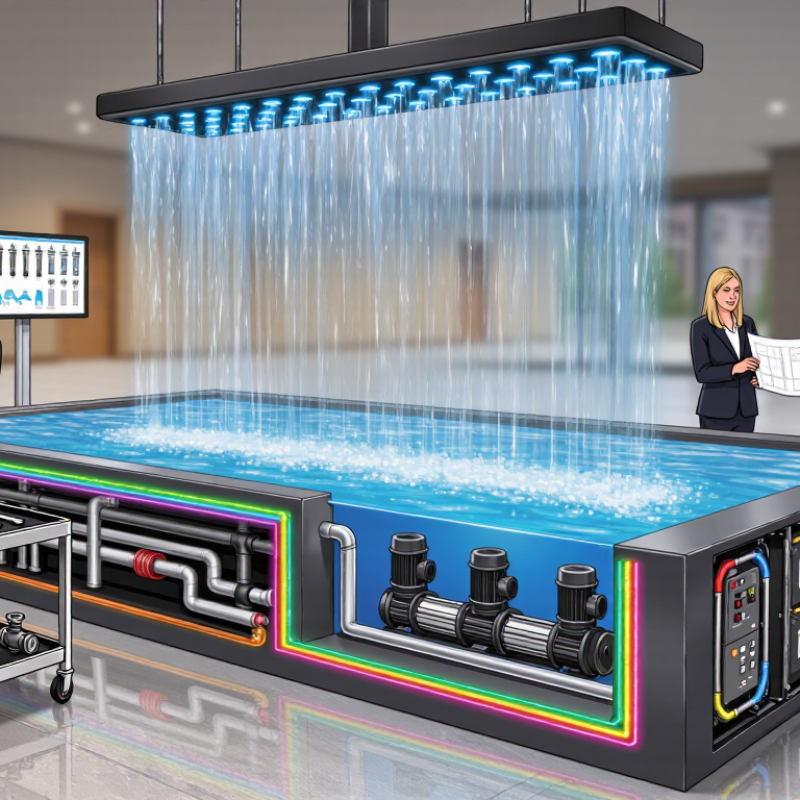
A digital water curtain is a programmable wall of falling water. It uses pumps, valves, nozzles, lighting, and control software. Each nozzle releases a timed water stream. Together, these streams create letters, logos, patterns, or moving images. Sensors and controllers adjust the timing within milliseconds. The effect looks like a screen, but gravity does the displaying.
Its performance depends on more than visual brightness. The U.S. Department of Energy’s Improving Pumping System Performance: A Sourcebook for Industry identifies pumping as a major industrial electricity load. The International Energy Agency’s Energy Efficiency 2023 report also states that buildings consume about 30% of global final energy. Therefore, a suitable supplier should provide pump efficiency data, standby power figures, and water-flow calculations. Ask for filtration details, nozzle spacing, software compatibility, and emergency shutoff response.
Do not trust a bright test video alone. A beautiful demo can hide uneven streams, noisy pumps, or difficult cleaning access. Request a live demonstration lasting at least thirty minutes. Check whether the image remains stable after repeated cycles. The U.S. Environmental Protection Agency reports that household leaks can waste more than one trillion gallons of water annually in the United States, showing why leakage control deserves attention. In practice, I would also inspect drainage, splash protection, maintenance records, and spare-nozzle availability. The supplier with the most dramatic sample may not be the safest long-term choice.
| Category | Evaluation Dimension | What It Means in Practice | What to Verify with a Supplier |
|---|---|---|---|
| Basic Concept | Definition | A digital water curtain is a programmable water-display system that releases controlled streams or droplets through electronically operated outlets to form images, text, patterns, or moving visual effects. | Request a system description showing the water-release method, outlet arrangement, control architecture, and intended display applications. |
| Operating Principle | Water-Drop Formation | Solenoid valves or comparable electronically controlled outlets open and close at timed intervals. The falling water is visually interpreted as lines, shapes, letters, or animated graphics. | Confirm valve response time, switching frequency, outlet spacing, and whether the supplier can demonstrate stable patterns at the proposed installation height. |
| Operating Principle | Recirculating Water System | Most permanent installations use a collection basin, pump, filtration equipment, piping, and a control system to circulate water rather than continuously discharge fresh water. | Check pump capacity, filtration stages, drainage design, water-level protection, cleaning access, and the expected make-up water requirement. |
| Display Quality | Resolution and Outlet Pitch | The visual resolution depends mainly on the number of outlet rows, outlet spacing, curtain width, water-drop consistency, viewing distance, and lighting conditions. Closer spacing generally supports finer patterns. | Ask for engineering drawings with outlet pitch, active display width, effective display height, sample content, and recommended viewing distance. |
| Display Quality | Content and Control | A controller synchronizes valve actions with programmed sequences. Depending on the system, content may include text, logos, geometric patterns, simple animations, schedules, and sensor-triggered effects. | Verify supported content formats, editing software, scheduling functions, offline operation, remote access, user permissions, and backup-control options. |
| Water Management | Water Quality | Suspended particles, scale, algae, and unsuitable chemical conditions can obstruct outlets, reduce clarity, and increase maintenance. Water treatment requirements vary with climate, source water, and installation type. | Obtain recommended filtration, disinfection, water testing, cleaning frequency, permissible water conditions, and a documented maintenance procedure. |
| Water Management | Water Consumption | A recirculating curtain mainly loses water through evaporation, splash, drift, drainage, and cleaning. Actual consumption depends on operating hours, climate, basin design, and display geometry. | Request a water-consumption estimate based on operating schedule, local climate, basin volume, evaporation assumptions, and cleaning activities. |
| Engineering | Pump and Hydraulic Design | The hydraulic system must deliver adequate flow and pressure to maintain uniform water release across the full curtain. Poor balancing may create uneven streams or blank areas. | Review hydraulic calculations, pump operating point, pipe sizing, balancing method, redundancy options, noise level, and protection against dry running. |
| Engineering | Structural Integration | The installation may require a support frame, overhead manifold, collection basin, access platforms, drainage connections, waterproofing, and coordination with architectural finishes. | Confirm load data, fixing details, corrosion protection, basin dimensions, access clearances, drainage interfaces, and responsibility for site coordination. |
| Safety | Electrical and Water Separation | Pumps, controllers, sensors, lighting, and valves must be designed for wet environments. Electrical protection should be selected according to the installation location and applicable local requirements. | Ask for enclosure ratings, grounding and residual-current protection provisions, cable-routing details, emergency shutoff design, and applicable compliance documentation. |
| Safety | Public-Access Protection | Public installations should control slippery surfaces, splash zones, accidental contact with moving parts, unauthorized access, and water-related hygiene risks. | Verify splash containment, anti-slip treatment, barriers or safe distances, emergency stop functions, cleaning procedures, and risk-assessment documentation. |
| Environment | Indoor or Outdoor Suitability | Outdoor systems face wind, rain, temperature changes, ultraviolet exposure, debris, and greater evaporation. Indoor systems require careful control of humidity, condensation, ventilation, and floor drainage. | Confirm the environmental operating range, wind-management strategy, weather protection, corrosion resistance, humidity control, and seasonal operating procedures. |
| Maintenance | Serviceability | Routine service commonly includes basin cleaning, filter maintenance, outlet inspection, pump checks, water-quality monitoring, valve testing, and software or controller backups. | Request a preventive-maintenance schedule, spare-parts list, access plan, troubleshooting guide, service response terms, and training for operating staff. |
| Reliability | System Redundancy | Critical installations may use backup pumps, sectional isolation, fault alarms, water-level sensors, and modular control zones to limit downtime when a component fails. | Compare single-point failure risks, alarm functions, isolation valves, replacement procedures, backup-power requirements, and recovery time after a fault. |
| Supplier Selection | Design and Customization Capability | A suitable supplier should be able to adapt outlet layout, curtain dimensions, content control, basin design, lighting, sensors, and architectural interfaces to the project conditions. | Evaluate concept drawings, hydraulic and structural engineering support, content-development capability, prototype testing, and the clarity of technical submittals. |
| Supplier Selection | Testing and Acceptance | Factory and site testing can verify water uniformity, display accuracy, control response, noise, leakage prevention, emergency stops, drainage, and programmed content. | Require a written testing plan with measurable acceptance criteria, test records, commissioning responsibilities, defect correction, and handover documentation. |
| Commercial Review | Total Cost of Ownership | The purchase price is only one part of the cost. Energy, make-up water, treatment chemicals, consumables, cleaning labor, replacement valves, software support, and access equipment affect long-term expenditure. | Request a lifecycle-cost estimate that separates equipment, installation, commissioning, utilities, maintenance, spare parts, software, and service fees. |
| Project Delivery | Documentation and After-Sales Support | Reliable operation depends on accurate as-built drawings, wiring diagrams, hydraulic schematics, operation manuals, maintenance instructions, spare-parts information, and trained personnel. | Confirm the handover document list, training format, warranty scope, software ownership, remote-support method, local service availability, and escalation process. |
Note: Performance, water use, maintenance intervals, and equipment specifications vary by project. Final selection should be based on site conditions, local regulations, engineering calculations, and a documented supplier proposal.
Ask for pump curves, flow-rate tolerances, nozzle spacing, and operating noise measurements. The supplier should explain pressure stability across the entire curtain. Beautiful renderings are not enough.
Look for filtration, a drainable basin, overflow protection, and easy cleaning access. Water-level sensors can reduce waste. They cannot replace inspections.
Confirm moisture protection, enclosure ratings, grounding methods, and emergency-stop access. Controllers should stay away from splash zones. Small oversights matter.
Request energy data under real operating conditions, not unloaded pump measurements. Correct pump sizing can reduce throttling and unnecessary power use. Actual site results may differ.
Specify installation height, display width, viewing distance, location, and daily operating hours. Also describe drainage, water treatment, control needs, and expected pattern changes. Vague requirements create avoidable revisions.
Request technical drawings, test videos, commissioning records, and similar project references. A small demonstration can reveal noise, spray behavior, and pattern quality. Test it closely.
Check spare-part availability, cleaning access, technical response times, and repair responsibilities. Confirm who manages software updates and emergency service. A low purchase price may hide maintenance costs.
Define acceptable flow rates, sound levels, spray coverage, water quality, and control performance. Include testing conditions and correction procedures. Some requirements may need revision after installation.
Inspect materials for humidity resistance and daily cleaning requirements. Confirm warranty coverage in writing, including response limits and replacement conditions. Promises can sound clearer than they are.
Choosing the best Digital Water Curtain supplier requires more than comparing product prices. A digital water curtain uses precisely controlled water streams, lighting, software, and mechanical components to create dynamic images, text, or visual effects. A reliable supplier should provide stable water flow, accurate nozzle control, durable materials, efficient lighting, user-friendly control systems, and safety-focused design. Technical performance should be evaluated alongside the supplier’s project experience, engineering capabilities, customization options, and ability to adapt the system to the installation site.
It is also important to compare the complete cost of ownership, including design, production, transportation, installation, training, maintenance, spare parts, and after-sales support. Suppliers should offer clear quotations, realistic delivery schedules, responsive technical assistance, and practical maintenance plans. The most suitable choice is the supplier that understands your project’s size, creative goals, operating environment, budget, and long-term requirements, while providing dependable quality and comprehensive support from initial planning through daily operation.