
SymphonyFountains Choosing a Water Screen Projection System requires more than comparing projector brightness or screen size. Water behaves like a living surface. Wind changes its shape, pumps affect its rhythm, and nearby lighting can weaken the image. A successful installation begins with the site, not the equipment catalogue.
Bart Kresa, founder of BartKresa Studio and an internationally recognized projection designer, describes the medium with a useful principle: “Water is a living screen, not a fixed wall.” This idea should guide every decision. Measure the viewing distance, water flow, screen width, ambient light, and available maintenance access. A system that looks impressive in a dark test room may appear weak beside streetlights or illuminated buildings. Brightness matters. Contrast matters more than many buyers expect.
Think about the audience.
The content also needs careful planning. Fine text, narrow lines, and pale colours may disappear across moving water. Strong silhouettes, bold contrast, and generous spacing usually perform better. Weather protection, pump reliability, projector housing, and emergency shutdown procedures deserve equal attention. These details are less glamorous, but they protect the experience and the investment.
There is no universal best system. A compact indoor fountain installation needs different specifications from a large outdoor show. Even experienced teams can misjudge wind, spray, or maintenance time. That uncertainty should be tested early, preferably with an on-site demonstration. The right Water Screen Projection System balances visual impact, operating conditions, serviceability, and long-term cost. It should create wonder without creating avoidable technical problems.
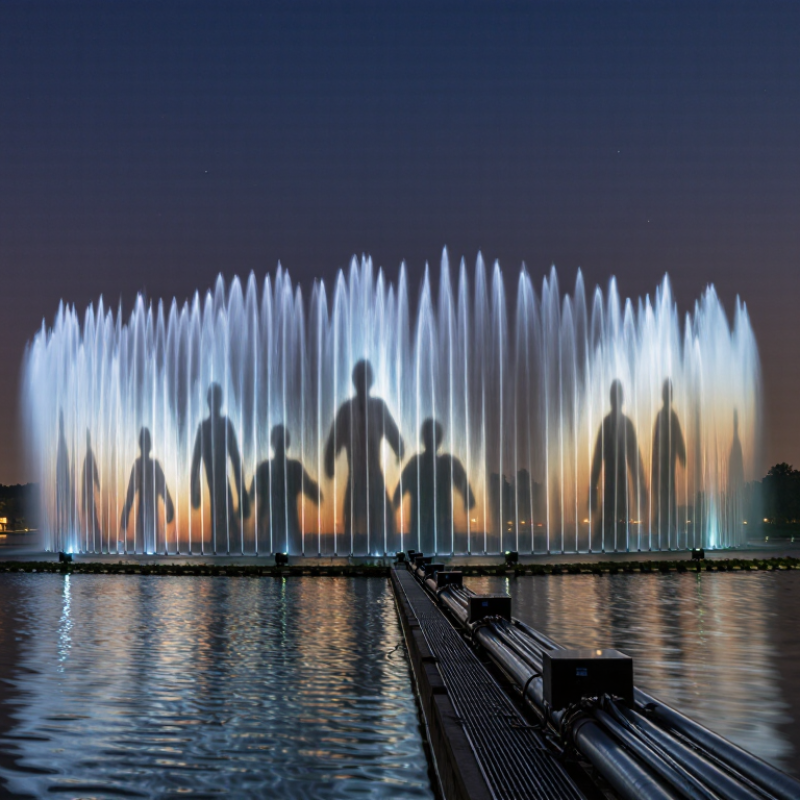
A water screen is defined by more than its visible mist. For stable projection, designers often target droplets between 1 and 3 mm. Smaller droplets evaporate quickly and may lose image density. Larger droplets can create gaps, splashes, and uneven edges. This range is a practical engineering target, not a universal standard.
Width, height, and shape must match the viewing distance. A 12-meter-wide screen may need a height of 5 to 7 meters for a balanced image, depending on content and audience position. A flat screen suits text and wide video. A fan-shaped screen creates stronger immersion but needs careful edge control.
The 2023 ASHRAE Handbook—HVAC Applications highlights airflow, humidity, and evaporation as important environmental variables. In practice, even a light crosswind can distort the upper edge. I have found that laboratory measurements can look perfect, yet outdoor performance still requires adjustment.
Tips:
Measure the screen at its operating height. Check droplet continuity with a white test image. Keep the projector aligned with the audience axis. Review CIE 150:2017 for spill light and glare considerations. Do not trust width alone; shape affects perceived brightness. Some unevenness is acceptable, but it should be intentional.
Choosing a water screen projection system starts with the projector’s brightness.
Outdoor shows usually need 10,000–30,000 ANSI lumens, depending on screen size and ambient light.
A compact water screen near a dark lake may work well around 10,000–15,000 ANSI lumens.
Larger screens, city lighting, or long viewing distances often require 20,000–30,000 ANSI lumens.
Brightness matters. However, more power does not automatically create a better image. Excessive brightness can wash out colors when the image surface is uneven.
I recommend checking the water screen width, projector throw distance, and audience position before choosing equipment. During a previous outdoor setup, nearby pathway lights weakened shadow detail, even though the projector met the recommended brightness. Turning off two lights helped more than increasing output. That result was easy to overlook.
Measure twice. Test at night.
A practical test should include white text, dark scenes, skin tones, and fast movement. Watch from the farthest audience area, not only beside the projector.
Weather also affects performance. Wind can distort the water curtain, while mist may soften fine details. A 30,000-lumen projector cannot fully correct unstable water flow.
The best choice balances ANSI lumens, contrast, resolution, screen dimensions, and site lighting. This balance is not fixed. It should be verified at the actual venue before the show.
Plan image geometry before selecting projectors.
Measure the usable water width, not the basin or viewing area. Small ripples can distort edges, so leave practical clearance around the image.
The 16:9 format remains a reliable starting point for video content.
It matches common production workflows and reduces unnecessary cropping. A 5-meter-wide screen should measure approximately 2.81 meters high.
According to CTA display standards, 16:9 is the established HDTV aspect ratio, while AVIXA’s 2024 Industry Outlook and Trends Analysis valued the professional AV market at about 306.4 billion dollars in 2023. That scale reflects why standardized image planning matters.
Edge blending becomes necessary when one projector cannot cover the required width or brightness.
Overlap should be planned with test grids, measured luminance, and careful alignment. A 10–20% overlap is often practical, but water movement may require adjustment.
Blending can hide seams, yet it cannot correct uneven spray or unstable surfaces. That part is easy to underestimate.
Field tests should include dark scenes, white text, and moving imagery.
Otherwise, a technically correct layout may still look visibly weak.
Choosing a water screen projection system starts with the enclosure, not brightness. Outdoor mist, spray, and condensation can reach equipment before the show begins. An IP65 enclosure is dust-tight and resists water jets from any direction. It is not designed for temporary immersion. That distinction matters near pumps and splash zones. During site checks, I inspect cable glands, door seals, ventilation, and mounting points. Small gaps become expensive problems.
Place projectors and control equipment above likely splash height, while keeping service access dry. Use correctly rated RCD/GFCI protection on circuits exposed to moisture. This device can disconnect power when leakage occurs, reducing shock risk. It does not replace grounding, bonding, insulation checks, or local electrical requirements. A qualified electrician should select ratings, test trip times, and verify the installation before operation. Keep connections off the ground.
I prefer a documented test log with dates, readings, and corrective actions. Paperwork feels slow, but memory is unreliable after repeated setup days. Choose sealed connectors and outdoor-rated cables, then protect cable runs from standing water and foot traffic. Allow drainage around the enclosure instead of trapping water beneath it. Before each performance, inspect cracked seals, loose covers, condensation, and unexplained trips. I have missed small details before. One overlooked fault can stop the projection.
IP65-rated enclosures are dust-tight and protected against water jets. The chart compares the standardized IEC 60529 dust and water protection levels of commonly considered enclosures.
IP ratings are coded from 0 to 6 for solids and from 0 to 9K for water protection; higher numbers indicate stronger tested protection within that category. IP65 is suitable for equipment exposed to dust and water jets, but it is not rated for immersion. Electrical supplies should also use an appropriately selected RCD/GFCI in accordance with local electrical codes and manufacturer requirements.
When choosing a water screen projection system, verify the output rather than trusting a specification sheet. A true 4K image should deliver 3,840 × 2,160 pixels from the source through the processor and projector. Check the test pattern at the installation distance. Fine text should remain sharp, not blurred by water droplets or scaling.
Contrast also needs practical testing. A 2,000:1 contrast ratio can improve dark scenes, but surrounding lights may weaken the effect. Test black areas at night, near the control position and audience seating. Look for gray blacks, uneven brightness, and visible gaps in the water curtain. A light meter can support the evaluation, although readings alone cannot describe the viewing experience.
Frame rate matters when content contains motion. A 30 fps signal may suit slow graphics, while 60 fps produces smoother movement during fast transitions. Confirm that the media server, processor, and projector support the same frame rate. Mixed settings can create judder. I have seen impressive 4K demonstrations fail after installation because the input was reduced to a lower format. Specifications are useful, but they are not proof. Recheck the complete signal chain under real operating conditions. Some imperfections remain, especially with wind, pump vibration, and uneven water flow. That deserves honest attention.
Most outdoor shows need 10,000–30,000 ANSI lumens. A dark lake may need only 10,000–15,000 lumens. City lights and large screens often require 20,000–30,000 lumens.
No. Excessive brightness can wash out colors on an uneven water surface. More power is not always better.
Measure screen width, throw distance, and audience positions. Use the usable water width, not the full basin. Leave clearance for ripples and edge movement.
Throw ratio equals projector distance divided by image width. A 1.5 ratio needs about 7.5 meters for a 5-meter-wide screen. Measure twice.
A 16:9 layout suits common video production workflows. A 5-meter-wide screen is about 2.81 meters high. It also reduces unnecessary cropping.
Edge blending helps when one projector cannot cover the required width or brightness. A 10–20% overlap is often practical. Moving water may require adjustment.
Test white text, dark scenes, skin tones, and fast movement. Watch from the farthest audience area. Test at night, not only beside the projector.
A true 4K signal should provide 3,840 × 2,160 pixels throughout the signal chain. Around 2,000:1 contrast can support darker scenes. Use 30 fps for slower graphics and 60 fps for smoother motion.
Not completely. Wind can distort the water curtain, while mist softens fine details. Pump vibration and uneven flow still remain visible. I may underestimate these effects without a full venue test.
Choosing a Water Screen Projection System requires careful coordination between the water feature, projection equipment, and viewing environment. Start by defining the screen’s width, height, and shape, using fine 1–3 mm droplets to create a smooth and consistent image surface. For outdoor shows, select a projector with approximately 10,000–30,000 ANSI lumens, depending on screen size, ambient light, and audience distance. Image geometry should also be planned in advance, including throw ratio, a 16:9 format, and edge blending when multiple projectors are required.
Equipment protection and output quality are equally important. Use IP65-rated enclosures where appropriate, and include RCD/GFCI protection to reduce electrical risks around water. Before installation, verify that the system can deliver the intended performance, such as 4K resolution, around 2,000:1 contrast, and a frame rate between 30 and 60 fps. Testing brightness, alignment, focus, and playback stability under realistic conditions will help ensure a clear, reliable, and visually engaging presentation.