 SymphonyFountains SymphonyFountains
 Direct factory supply of IP68 stainless steel, resin-filled, DMX512-controlled underwater RGB/RGBW lights engineered for architectural fountains, commercial pools, and harsh marine environments.
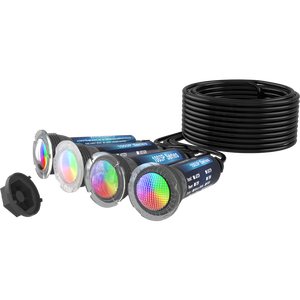
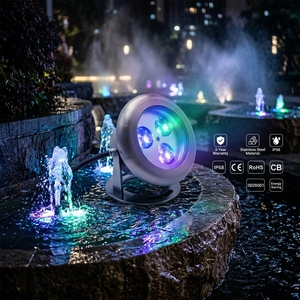
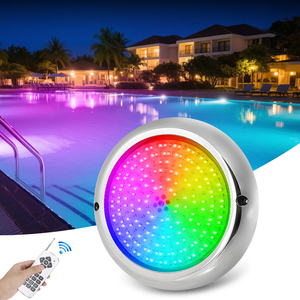
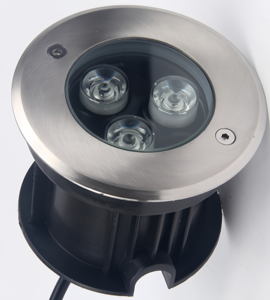
In municipal water feature engineering and commercial swimming pool installations, CE marking is not merely a trading pass—it represents strict adherence to complex European Union directives regarding low-voltage electrical safety, electromagnetic compatibility (EMC), and photobiological hazards.
The standard EN 60598-2-18 dictates safety requirements specifically for luminaires used in swimming pools and similar underwater applications. CE certified factories must guarantee Safety Extra Low Voltage (SELV) operation under 12V AC or 24V DC to eliminate electric shock hazards.
Submersible RGB luminaires utilize high-frequency Pulse-Width Modulation (PWM) dimming ICs. Compliance requires robust filtering circuitry to prevent high-frequency electromagnetic interference from disrupting nearby water pumps, automated valves, or audio control systems.
True IP68 rating requires verified continuous immersion under specified pressure. Premier manufacturers subject fixtures to 0.1MPa (10 meters depth equivalent) hydrostatic pressure testing for a minimum of 72 hours before factory clearance.
Selecting the optimal material housing is critical to prevent crevice corrosion, galvanic degradation, and premature LED lumen depreciation caused by chemical exposure in chlorinated pools or high-salinity seawater applications.
| Material Specification | Corrosion Resistance (PREN) | Ideal Application Environment | Thermal Dissipation Capacity | Mechanical Durability |
|---|---|---|---|---|
| SS304 Stainless Steel | 18.0 - 20.0 | Freshwater fountains, indoor decorative basins (Chlorine < 2 ppm) | Moderate (16.3 W/m·K) | High Structural Integrity |
| SS316L Marine Steel | 23.0 - 25.0 | Commercial swimming pools, chlorinated waters (Chlorine 2-5 ppm) | Superior (16.3 W/m·K) | Vandalism Proof / Heavy Duty |
| Full Resin-Filled Polycarbonate | N/A (Non-Metallic Chemical Inert) | High-salinity seawater, saltwater chlorinator pools (> 3500 ppm salt) | Optimized via Thermal Conductive Resin | 100% Water Leakage Proof |
| Anodized Machined Aluminum | Low (Requires specialized coating) | Out-of-water splash zones, dry-deck fountain perimeters | Highest (205 W/m·K) | Lightweight / Precision Engineered |
In underwater lighting, crevice corrosion frequently occurs beneath sealing gaskets and screw heads where oxygen replenishment is restricted. Certified factories mitigate this by utilizing passivated SS316L stainless steel containing 2-3% Molybdenum. Furthermore, structural design engineers implement seamless CNC-lathed casings paired with high-grade EPDM O-rings, effectively eliminating micro-gaps where aggressive chloride ions accumulate.
LED junction temperature ($T_j$) directly dictates operational lifespan. Underwater luminaires rely on water immersion for thermal dissipation. However, dry-run conditions (when fountains are drained or turned off while lights remain active) can cause catastrophic junction overheating within minutes. Premier OEM suppliers integrate smart NTC thermal sensors with constant-current drivers that automatically throttle power by 50-80% when ambient temperatures surpass 65°C.
The global underwater landscape lighting market is undergoing rapid technological convergence. B2B buyers and specifiers must align procurement strategies with emerging smart control protocols and sustainability benchmarks.
Traditional multi-wire color switching is obsolete for commercial projects. Modern procurement specifies bi-directional Remote Device Management (RDM), allowing control consoles to query real-time voltage, LED junction temperature, and operational hours from individual submerged fixtures without manual physical inspection.
Specifiers now demand RGBW (with dedicated 3000K Warm White or 6000K Daylight White chips) over traditional RGB. This eliminates muddy white rendering. Leading factories enforce strict 3-step MacAdam Ellipse binning (SDCM < 3) across manufacturing batches to guarantee color uniformity across massive fountain installations.
Civic and hospitality upgrades are abandoning heavy, water-filled recessed niches in favor of surface-mounted, low-profile nicheless designs. Standardized 1.5-inch thread connections allow seamless replacement of legacy halogen systems with energy-efficient LED modules without requiring destructive concrete re-engineering.
Referencing decades of engineering legacy from elite water-feature manufacturers like Symphony Fountains, top-tier Chinese manufacturing facilities offer fully integrated production pipelines built for rigorous international compliance.
Every luminaire optical design is optimized via integrated goniophotometric analysis and integrating sphere testing. Factories measure absolute lumen output, beam angle distribution (narrow 8° spot for tall fountain jets to 120° flood for pool illumination), and chromaticity coordinates under actual submerged operating conditions.
Quality assurance follows ISO 9001 protocols. Prior to packaging, 100% of manufactured luminaires undergo a multi-stage stress test: 24-hour continuous burn-in under electrical load, followed by hyperbaric pressure chamber immersion to guarantee zero water ingress under field conditions.
Crucial engineering insights, electrical calculations, and regulatory guidance for MEP engineers, procurement managers, and lighting distributors.
While both comply with Safety Extra Low Voltage (SELV) regulations, DC24V is vastly superior for commercial installations due to voltage drop dynamics. DC24V cuts electrical current in half compared to AC12V for equivalent wattage ($P=V \times I$). This significantly reduces copper cable resistance losses over long cable runs (e.g., 50–100 meters from equipment room to basin), allowing thinner cable gauges, lower installation costs, and perfectly uniform luminaire brightness without flicker.
Air-cavity lights rely on physical rubber gaskets and mechanical screws to seal the glass face to the metal housing. Over time, thermal expansion/contraction cycles and chemical degradation can compromise gasket seals, leading to moisture condensation. Resin-filled lights inject high thermal-conductivity polyurethane resin directly into the housing, surrounding the LED PCB entirely. This eliminates internal air volume, making water ingress physically impossible even if outer lenses are damaged.
EN 62471 evaluates blue light hazards and photobiological radiation from intense light sources. High-power RGB/RGBW underwater LEDs utilize primary and secondary optics (such as PMMA lenses) engineered to diffuse direct optical radiation while maintaining punchy beam candlepower. Certified manufacturers ensure luminaires fall into Risk Group 0 (Exempt) or Risk Group 1 (Low Risk), preventing retinal injury to swimmers looking directly at submerged light sources.
DMX512 operates over RS-485 differential signaling. In large aquatic installations, signal reflection and attenuation occur due to long cable lengths and moisture capacitance. Factory engineering standards mandate installing DMX signal repeaters/isolated splitters every 32 fixtures or 150 meters, along with a 120-ohm impedance matching termination resistor across Data+ and Data- at the final fixture in the daisy chain.
For standard freshwater fountains and lightly chlorinated pools (< 2 ppm free chlorine), SS304 stainless steel provides adequate resistance. For commercial swimming pools, salt-chlorinator systems (generating 3,500+ ppm NaCl), or direct seawater applications, SS316L (or 316) is strictly required due to its Molybdenum content, which dramatically increases Pitting Resistance Equivalent Number (PREN > 23). In coastal applications, full resin-encapsulated housings remove metal corrosion risks entirely.
Accelerate your project specification with direct factory pricing, custom OEM/ODM optical engineering, IES photometric reporting, and guaranteed CE/IP68 compliance documentation.
Contact Us