 SymphonyFountains SymphonyFountains
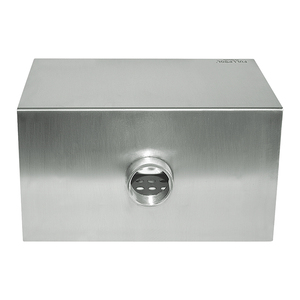
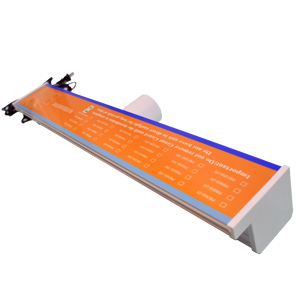
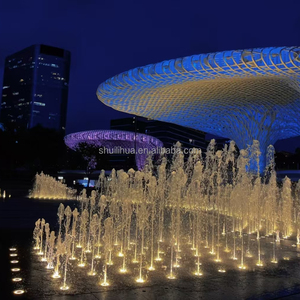
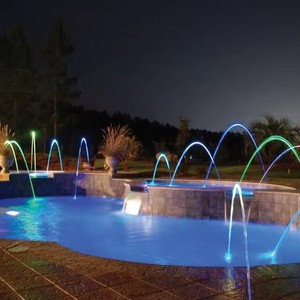
In modern architectural water features, the evolution from static waterfalls to high-definition Graphic Water Curtains (Digital Water Curtains) represents a paradigm shift in spatial design, interactive entertainment, and commercial branding. As China’s premier graphic water curtain manufacturer and original equipment factory, our engineering operations combine high-frequency hydrodynamic physics, automated solenoid valve arrays, and low-latency digital signal processing (DSP) to transform falling water into real-time dynamic text, intricate vector patterns, and high-resolution graphical sequences.
Achieving pixel-perfect clarity in a free-falling liquid matrix requires precise stabilization of Rayleigh-Plateau instability. When liquid exits a nozzle, surface tension forces the water stream to break down into discrete droplets. By controlling the initial velocity ($v_0$), nozzle orifice diameter ($d$), pressure drop across the manifold ($\Delta P$), and high-speed solenoid actuation timings ($\Delta t$), our digital water curtain systems generate uniform, controlled water drops that act as physical light-refracting pixels in mid-air.
As a fully integrated OEM/ODM manufacturing facility based in China, our factory spans over 15,000 square meters of modern industrial space equipped with multi-axis CNC machining centers, laser cutting equipment, automated surface treatment lines, and hydraulic test bays. Unlike third-party assemblers, we manufacture core structural components—including SS316L nozzle manifolds, brass solenoid cores, custom PCB driver boards, and IP68 sealed waterproof enclosures—under strict ISO 9001:2015 quality management standards.
The structural integrity of a graphic water curtain header relies heavily on material selection and tolerances. We utilize heavy-gauge Stainless Steel 304 or 316L, precision-drilled via high-accuracy CNC gantries to maintain hole pitch accuracy within $\pm 0.05 \text{ mm}$. Our dual-chamber pressure equalization design ensures that water arriving from feed pumps is evenly distributed, suppressing turbulence before it reaches the solenoid valve inlets.
The heart of a digital graphic curtain is its valve module. Standard off-the-shelf industrial solenoids fail rapidly under continuous high-frequency pulsing. Our factory-engineered valves feature:
Every graphic water curtain module undergoes rigorous 72-hour continuous burn-in testing prior to crate packaging. Testing procedures include 100% pressure vessel verification at 1.5$\times$ working pressure, optical drop-formation calibration using high-speed camera sensors, and total electrical insulation testing ($> 100 \text{ M}\Omega$ at 500V DC).
Selecting the appropriate water feature technology requires evaluating flow mechanics, structural limitations, and digital display resolution. The data table below outlines performance metrics across standard architectural water wall configurations:
| System Specification | HD Graphic Water Curtain | Standard Digital Water Screen | Architectural Cascade Wall |
|---|---|---|---|
| Pixel Density / Pitch | up to 64 pixels/meter (15.6mm) | Non-pixelated Mist Curtain | N/A Continuous Sheet |
| Valve Response Time | 10 ms – 15 ms | 50 ms – 100 ms | N/A (Continuous Flow) |
| Operating Water Pressure | 0.8 bar – 1.8 bar | 3.0 bar – 6.0 bar | 0.3 bar – 0.8 bar |
| Flow Rate Requirement | 120 – 180 L/min per meter | 300 – 500 L/min per meter | 200 – 450 L/min per meter |
| Interactive Vector Display | Yes (Text, Logos, Animations) | Projection Only | No Display Capability |
| Max Recommended Height | 12 Meters (Indoor/Outdoor sheltered) | 30+ Meters (Outdoor open water) | Unlimited (Structure supported) |
| Structural Frame Material | SS316L / Anodized Aluminum 6061 | SS304 Heavy Frame | Civil Masonry / Glass / SS |
As municipal centers, shopping malls, theme parks, and corporate headquarters demand increasingly interactive public art installations, the graphic water curtain market is rapidly evolving. Key procurement trends shaping future RFP requirements include:
Modern installations are moving away from fixed loop image playback toward generative visual graphics. Integrating computer vision cameras and depth sensors (e.g., LiDAR, Time-of-Flight sensors) allows water curtain systems to dynamically alter graphics in response to pedestrian movements, writing user names in water or creating "openings" in the water curtain as visitors approach.
The market demand for ultra-high-definition water printing has spurred research into micro-nozzle technology. By reducing nozzle pitch down to 5 mm to 8 mm, digital water displays can execute high-contrast Chinese characters, complex QR codes scanned directly by smartphone cameras, and intricate corporate logos with minimal edge blur.
Sustainability metrics are now critical in B2B water feature tenders. Next-generation graphic water curtain designs integrate variable frequency drives (VFDs) for pump speed optimization, high-efficiency UV-C inline sterilizers, and automated backwash multi-stage sand filters. This closed-loop water management minimizes water loss due to evaporation and maintains water clarity (turbidity $< 1 \text{ NTU}$), preventing bio-film accumulation inside micro-solenoid valves.
Remote operational monitoring is becoming standard across export markets. Integrated IoT controllers stream real-time operational telematics—including manifold line pressure, coil operating temperatures, current draw, and fluid turbidity—to cloud dashboards. Maintenance engineers receive automated alerts before solenoid failure occurs, eliminating unplanned downtime for high-profile commercial assets.
To assist MEP consultants, landscape architects, and procurement teams in sizing auxiliary infrastructure for graphic water curtain systems, our factory engineering team recommends the following core calculations:
To determine total water circulation requirements for a graphic water curtain of length $L$ (in meters) with nozzle pitch $P$ (in meters) and single-nozzle flow rate $q$ (typically $0.05 \text{ L/sec}$ at 1.2 bar):
$$N_{nozzles} = \frac{L}{P} + 1 \quad \implies \quad Q_{total} (L/min) = N_{nozzles} \times q \times 60$$
Example: For a 6-meter graphic water curtain with a 15.6mm pitch ($P = 0.0156 \text{ m}$), $N \approx 385 \text{ nozzles}$. At $0.05 \text{ L/sec}$ per valve, $Q_{total} = 385 \times 0.05 \times 60 \approx 1,155 \text{ L/min}$ ($69.3 \text{ m}^3\text{/h}$).
To prevent water splash out and guarantee positive pump suction head:
Partner directly with China's leading graphic water curtain manufacturer. Submit your site drawings, dimensions, or tender specs for detailed CAD drawings, hydraulic calculations, and factory-direct pricing.
Send an Inquiry