 SymphonyFountains SymphonyFountains
 Explore our precision-engineered water feature hardware designed for commercial plazas, luxury pools, interactive dry decks, and municipal water shows.
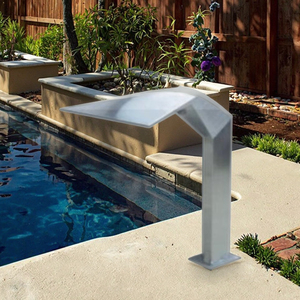
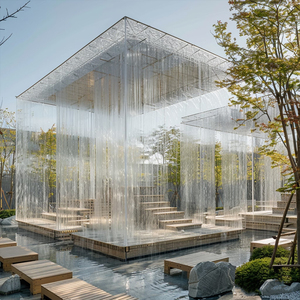
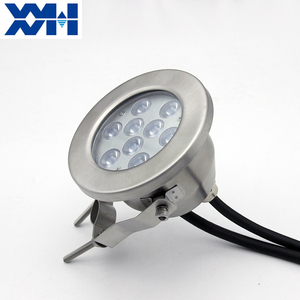
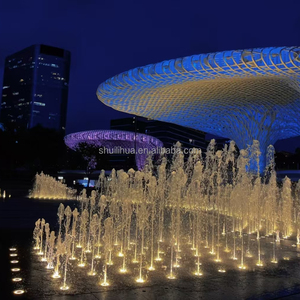
An in-depth technical breakdown of fluid mechanics, laminar water film stability, metallurgy specifications, and custom OEM manufacturing methodologies for architects and hydraulic project engineers.
Mushroom fountain nozzles (frequently designated as water bell nozzles or umbrella fountain jets) operate on the principles of thin-film fluid dynamics. The nozzle directs water through an adjustable top deflection cap, creating a continuous, transparent sheet of water shaped like an inverted dome or mushroom cap.
Achieving a smooth, clear water film requires maintaining a low Reynolds number (Re < 2000) at the exit discharge zone. Our custom OEM designs incorporate internal flow-straightening vanes and pressure-equalization chambers to minimize turbulence, preventing early breakdown of surface tension across varying flow rates.
As a specialized OEM exporter, we fabricate mushroom fountain nozzles using premium solid stainless steel stock or heavy-gauge cast alloys, strictly adhering to global ASTM standards.
For standard freshwater municipal fountains, AISI 304 Stainless Steel provides exceptional tensile strength and chemical resistance. However, for saline water features, coastal resorts, or heavily chlorinated swimming pool environments, we recommend AISI 316L Stainless Steel with molybdenum content (2.0% - 3.0%) to guarantee protection against severe pitting and crevice corrosion.
Custom OEM manufacturing for water feature projects requires precise coordination between architectural rendering specs and hydraulic pump curves. Our factory employs a rigorous 5-step OEM customization workflow to ensure zero-defect production:
How emerging smart hydraulic systems, sustainability mandates, and supply chain shifts are redefining commercial landscape fountain procurement.
Modern architectural projects demand low power consumption. Modern mushroom fountain nozzles are designed to integrate seamlessly with Variable Frequency Drives (VFDs). By modulating pump speeds, the mushroom water umbrella can gracefully swell and contract from a small, low-flow dome to a broad transparent canopy without losing film continuity, reducing operational energy costs by up to 40%.
The future of fountain design lies in optical physics. Mushroom water films act as perfect rear-projection surfaces for underwater LED lighting. Future-ready OEM nozzles are engineered with integrated light pass-through conduits, allowing DMX512 and RDM-controlled RGBW lights to illuminate the water film from within, creating mesmerizing glowing glass-like water sculptures at night.
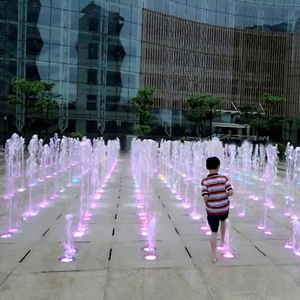
Commercial real estate developers are shifting toward zero-depth interactive play plazas. Custom mushroom nozzles are modified with flush-mount, anti-trip stainless steel housings and soft-edge deflectors that prevent injury while providing safe, splash-free tactile water interactions for children in urban parks and shopping centers.
Global procurement teams prioritize vendors offering standardized modular threading and complete pre-tested kits. By providing standardized OEM components with standardized BSP/NPT connection flanges, export delays and field modification expenses are reduced by up to 60%.
We combine vertically integrated manufacturing, advanced hydraulic testing, and single-source accountability to deliver superior water feature products worldwide.
We do not outsource. From initial nozzle casting and high-precision CNC turning to control panel assembly and underwater LED fixture sealing, every core system component is manufactured in-house.
Our dedicated flow-testing basins measure actual spray height, water film diameter, discharge velocity, and pressure drops across various pump ratings before any shipment leaves our facility.
All raw materials are accompanied by EN 10204 3.1 Mill Test Certificates. Our underwater LED lights hold IP68 waterproof ratings and CE, RoHS, and ISO9001 certifications.
We provide full white-label manufacturing, custom logo laser engraving, specialized packaging design, and complete CAD/3D BIM drawings for smooth site installation.
Common technical questions regarding custom mushroom fountain nozzle selection, installation, maintenance, and international OEM procurement.
Mushroom fountain nozzles feature an adjustable top cap connected to a threaded central spindle. By rotating the top deflector cap, you alter the discharge gap width. A smaller gap produces a thinner, wider water bell that requires higher pressure, while a wider gap results in a thicker, narrower water sheet. Fine-tuning pump inlet valves or VFD speeds further optimizes the final effect.
For standard sizes (DN20 to DN50 in SS304/SS316), our MOQ starts at 10 units. For fully customized OEM orders requiring special thread pitches, unique deflector geometries, or custom PVD coatings, the MOQ is typically 50 units. Standard production lead times range from 10 to 20 working days depending on total order volume.
Uneven water film breakdown is generally caused by three issues: 1) Physical debris or mineral scale trapped in the narrow circumferential discharge slot; 2) Micro-turbulence from an unstable upstream water supply (insufficient straight pipe length before the nozzle); or 3) Excessive crosswind conditions exceeding 3 to 4 m/s. Installing inline basket strainers and internal flow-straightening grids resolves most hydraulic issues.
Yes! Mushroom water bell nozzles are widely used in children's wading pools, SPA hydrotherapy pools, and hotel splash pads. They provide a visual water curtain and a gentle downward water flow suitable for shoulder and head massage. For chlorinated or saltwater pool systems, we strongly recommend specifying marine-grade SS316L material to prevent corrosion.
To receive an accurate engineering quote, please provide: 1) Desired inlet thread diameter (e.g., 1", 1.5", 2" BSP/NPT); 2) Preferred stainless steel grade (SS304 or SS316L); 3) Target water bell diameter and spray height; 4) Estimated operating flow rate/head pressure; and 5) Total project volume and delivery target date.