 SymphonyFountains SymphonyFountains
 Engineering high-performance underwater lighting systems requires strict adherence to structural waterproofing, spectral decay dynamics, and thermal dissipation metrics. This benchmark evaluates elite underwater LED light factories and suppliers providing IP68-rated luminaires for commercial fountains, water features, theme parks, and architectural water infrastructure.
Direct factory OEM/ODM solutions engineered with SS316L stainless steel, integrated DMX512 dynamic control, and advanced thermal management for extended underwater service lifespans.
Evaluating a manufacturer or supplier of underwater LED fountain lights requires rigorous technical verification beyond standard commercial illumination parameters. Submerged electrical fixtures face continuous hydrodynamic stress, chemical exposure (chlorine, salinity, algaecides), and severe thermal entrapment. Leading manufacturers separate themselves through precision engineering across four foundational pillars:
True IP68 compliance requires continuous submersion performance at specified depths (typically 5 to 50 meters), not merely temporary immersion. Premier factories utilize dual-component polyurethane potting resins or structural silicone injection alongside vulcanized EPDM O-ring gaskets. The cable entry gland—historically the primary failure point—must feature an internal anti-capillary block to prevent water wicking through the wire copper strands into the PCB chamber.
Water acts as a natural heatsink, but improper PCB layout creates localized hot spots that rapidly degrade LED micro-diodes. Leading suppliers use metal-core PCBs (MCPCB) bonded directly to heavy cast AISI 316L stainless steel housing. Integrated thermal feedback circuitry automatically dims the driver output if the fixture is operated dry during installation or maintenance cycles, preventing catastrophic thermal runaway.
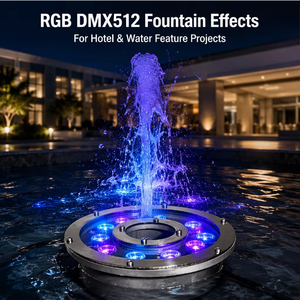
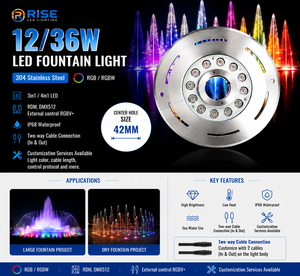
For musical and dancing water features, fixture latency must be near-zero (<20ms response time). Professional factories build native DMX512-A chips directly inside the fixture base, eliminating external decoder boxes. Advanced suppliers integrate Remote Device Management (RDM), allowing technicians to remotely read temperature metrics, operating hours, and readdress DMX channels without retrieving submerged hardware from the basin.
Water selectively attenuates longer wavelengths (reds and yellows) faster than shorter wavelengths (blues and greens). Top suppliers perform chromatic lux attenuation compensation, selecting optics with narrow beam angles (15° to 45°) and anti-reflective tempered glass lenses that maximize lumen penetration through turbulent water columns up to heights exceeding 30 meters.
Compare manufacturing grade specifications across standard vs high-tier commercial underwater fixtures:
| Evaluation Parameter | Standard Commercial Grade | Industrial High-Tier (Factory Direct) | Project Impact / Benefit |
|---|---|---|---|
| Housing Material | Stainless Steel 304 / Aluminum | Solid Cast SS 316L / Marine Bronze | Zero pitting corrosion in chlorinated or saltwater environments. |
| Waterproofing Sealing | Single Silicone Ring Seal | Dual EPDM Gasket + Anti-Capillary Resin Potting | Prevents internal condensation and seal fatigue over 5+ years. |
| Glass Cover | Standard Annealed Glass | 8mm-12mm High-Transmittance Toughened Glass | Withstands high hydraulic pressure jets and mechanical impacts. |
| Control Driver Protocol | Analog PWM / On-Off External Switch | Integrated Native DMX512-A & RDM Telemetry | Precise 16-bit dimming and color synchronization with music timeline. |
| Operating Voltage | AC 220V (High Risk) | Safety Low Voltage DC 24V (IEC 60598-2-18) | Total electrical safety compliance for public swimming & dry deck fountains. |
When underwater LED lights, submersible pumps, nozzles, and control panels are procured from fragmented suppliers, system integration issues inevitably arise: lights fail to map correctly to controller addresses, dynamic PWM frequencies generate electromagnetic interference (EMI) in water pumps, and accountability vanishes when show timing fails.
As a unified equipment manufacturer, Symphony Fountains designs and fabricates the entire hydraulic, illumination, and electronic control stack under one roof in Vadodara, India. By matching nozzle fluid dynamics with custom underwater LED optics, we eliminate compatibility gaps before equipment arrives on site.
From free concept site design to custom SS manufacturing, on-site commissioning, and AMC maintenance contracts.
Supplying overseas buyers with tailored hydraulic calculations, electrical wiring schematics, and programmed control racks.
Every LED luminaire undergoes 100% pressurized water chamber testing and 72-hour continuous electrical burn-in prior to dispatch.
The commercial water display and architectural illumination industries are transitioning toward smarter, more sustainable, and high-density lighting architectures. Procurement officers and B2B buyers must evaluate manufacturers based on their adoption of next-generation technology trends:
Legacy RGB fixtures struggle to produce saturated pastels and clean 4000K daylight white. Modern factories integrate 4-in-1 chipsets (RGBW / RGBA) with high Color Rendering Index (CRI > 90), enabling subtle gradient transitions for sophisticated architectural water screens.
Future-proof installations require remote health monitoring. Advanced suppliers build micro-sensors inside underwater LED housings to track operational voltage drops, moisture ingress humidity thresholds, and junction temperatures via cloud dashboard connectivity.
With rising municipal energy costs, commercial fountain suppliers are optimizing LED driver topologies for direct integration with DC battery banks and solar photovoltaic systems, operating smoothly within 12V-24V DC tolerance bands without inverter power losses.
Essential technical insights for engineering consultants, municipal planners, and project contractors.
Light attenuates rapidly in water due to scattering and absorption. As a standard engineering benchmark: for jet heights under 3 meters, a 12W to 18W RGBW fixture with a 30° beam angle is sufficient. For high-energy vertical jets exceeding 10 to 15 meters, select 36W to 54W fixtures with narrow 10°–15° optical lenses. Always factor in water turbidity; chlorinated pool water has an attenuation factor of roughly 0.15/m, whereas untreated lake water can attenuate up to 40% of lumen intensity per meter of sub-surface depth.
Safety and voltage drop efficiency drive this standard. Under international electrical safety guidelines (such as IEC 60598-2-18 for swimming pools and water features), voltage inside accessible basins must not exceed Safety Extra Low Voltage (SELV) limits (typically 30V AC / 60V DC). DC24V is safer for public immersion than AC220V while experiencing significantly lower current draw and line-loss voltage drop over long cable runs than AC12V systems, allowing longer runs between the central control panel and distant fixtures.
Cable wicking occurs when water enters a damaged outer cable jacket and travels along the internal copper strands into the sealed fixture body via capillary action (driven by negative pressure created when the lamp turns off and cools). Top-tier factories prevent this by embedding an anti-capillary block or solid resin epoxy barrier directly at the wire junction inside the cable gland assembly, effectively isolating the internal electronics even if the external power cable is cut underwater.
Standard RGB auto-change lights operate on fixed, un-synchronized internal timers, causing fixtures to drift out of color harmony after a few minutes. DMX512 is an international digital communication protocol that allows a central controller to command up to 512 individual channels per universe at 44 updates per second. This enables precise per-fixture color synchronization, smooth dimming curves, and millisecond-level coordination with musical beats, solenoid water valves, and variable frequency pump speed changes.
AISI 316L contains 2% to 3% molybdenum, an alloying element that drastically increases resistance to pitting and crevice corrosion in chloride-rich environments (such as chlorinated pool water, coastal sea breeze regions, or chemically treated fountain basins). AISI 304 lacks molybdenum and will develop brown surface tea-staining and crevice corrosion around glass seals over 12 to 24 months of continuous immersion.
Always require authentic IP68 test certification reports from accredited laboratories (verifying submersion depth and duration), CE/RoHS compliance marks, IEC 60598-2-18 safety compliance documentation, salt-spray corrosion test reports (ASTM B117), and material mill test certificates confirming SS316L chemical composition. Requesting photometrically tested IES files is also recommended to allow optical simulation in software like DIALux.
Need custom IP68 underwater LED fountain lights, center-hole ring lights, or complete DMX512 control systems for your upcoming project? Connect directly with our engineering team for free concept design assistance, technical CAD drawings, and factory direct quotations.